Keeping score in Cabo, from a winning Cabo to the + 10
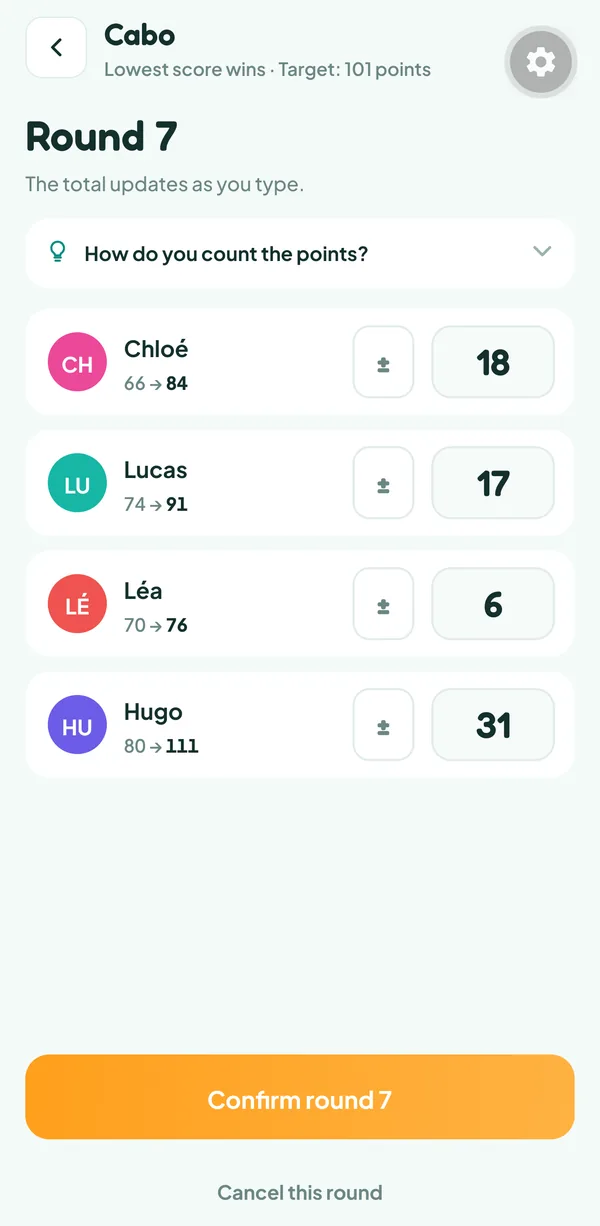
At the end of each round, you type everyone's points, 0 for a winning Cabo, their cards + 10 for a missed one: Teamzy adds up the totals, ranks from lowest to highest and ends the match as soon as a total goes above 100. While you type, the “How do you count the points?” help reminds you how to score.
Cabo in 30 seconds
Cabo is a card game by Melissa Limes and Mandy Henning, whose second edition Bezier Games published in 2019: its cards are numbered from 0 to 13. Everyone gets four cards face down, in a line, and looks at only two of them at the start. On your turn, you take a card, from the deck or the discard pile, and put it in place of one of yours; a card from the deck can also go straight to the discard pile, and some then have a power: peek, spy, swap. The goal: have as few points as possible in front of you. When you think you have the lowest total, call “Cabo” instead of taking your turn: everyone else plays once more, then all players turn their cards over and count. Points add up from round to round, the match ends as soon as a total goes above 100, and the lowest total wins.
What everyone scores
At the end of the round, everyone turns their cards over and adds them up: each card is worth the number on it, from 0 to 13. The player who called Cabo scores 0 with the lowest total, even a tie; otherwise, they score their cards + 10. Everyone else scores their cards. Then each player adds their points to their total: in Cabo, you want the lowest score.
The points of a round
| What counts | Points |
|---|---|
| Each card | its value |
| Called Cabo with the lowest score | 0 |
| Called Cabo without the lowest score | their cards + 10 |
One round worked out, card by card
The last round of the match told below: everyone's four cards at the end, their total and what each player scores. Lucas called Cabo with 7, but Léa has only 6: his Cabo is missed, he scores 7 + 10.
| Player | Their cards | Sum | Points |
|---|---|---|---|
| ChloéSwaps her 10 for a 5 | 3456 | 3 + 4 + 5 + 6 | 18 |
| Lucas (called Cabo)Calls Cabo with 7: missed | 0124 | 0 + 1 + 2 + 4+ 10 (missed Cabo) | 17 |
| LéaThe lowest total, 6 | 0123 | 0 + 1 + 2 + 3 | 6 |
| HugoGets Léa's 12 | 12865 | 12 + 8 + 6 + 5 | 31 |
The example's score sheet
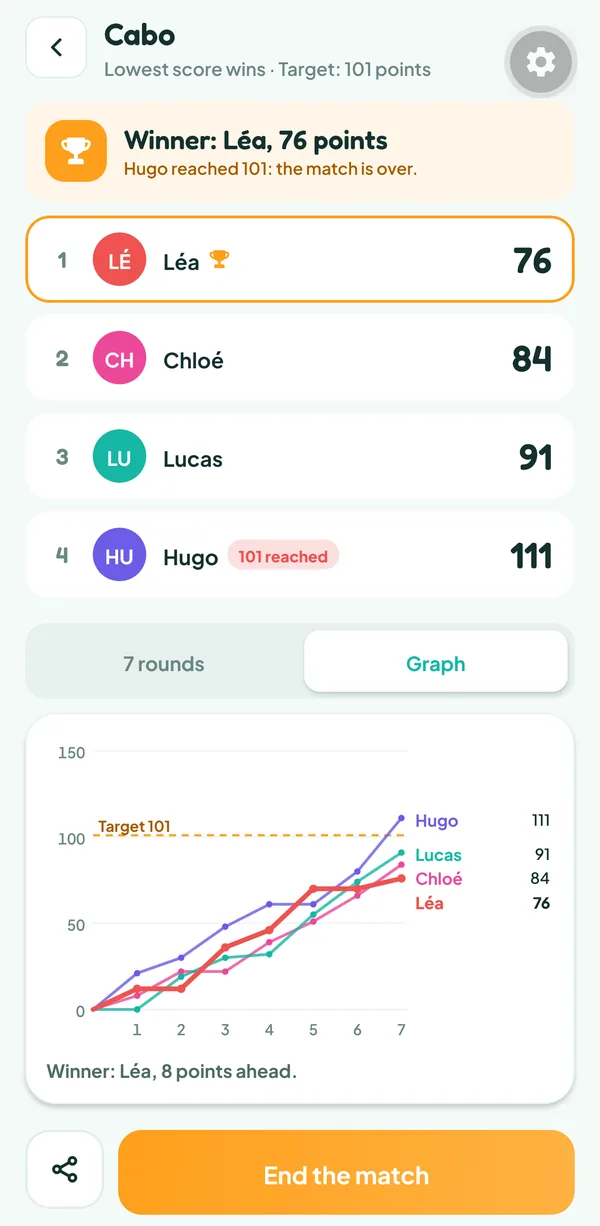
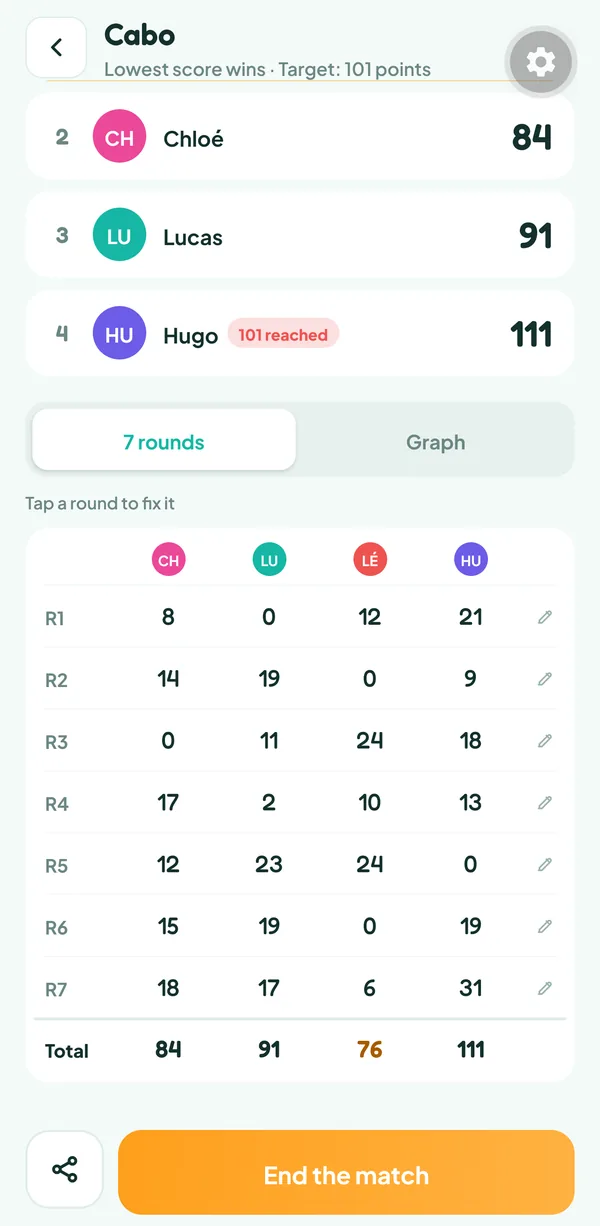
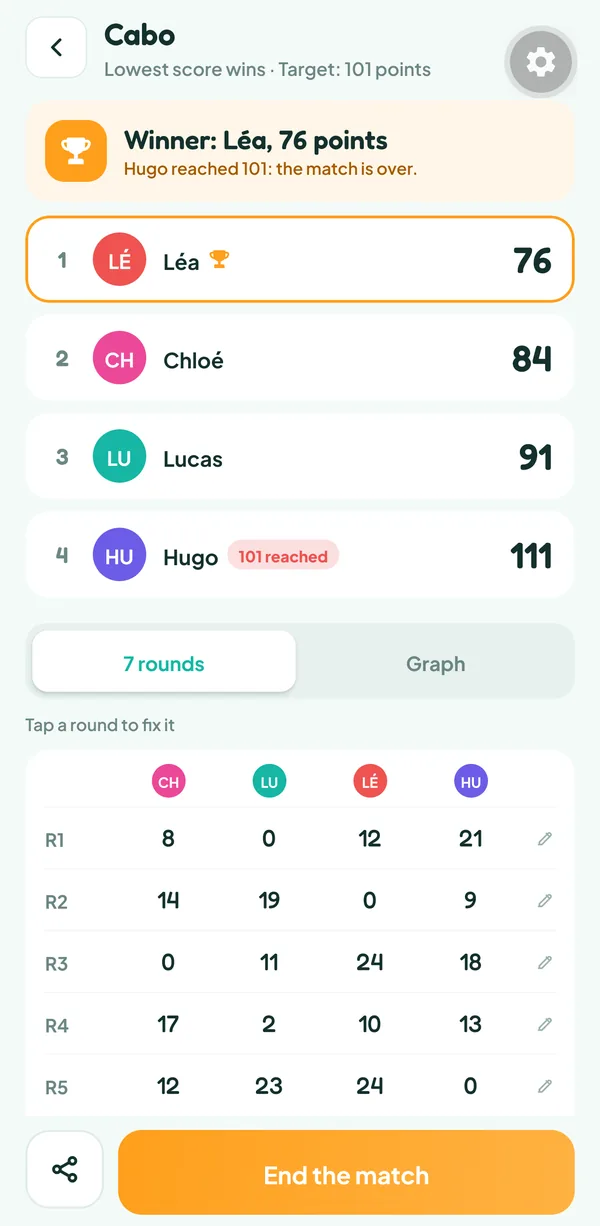
The seven rounds of the match told below, with everyone's points as you write them down. The dot ● marks who called Cabo: 0 when they had the lowest total, their cards + 10 otherwise, like Hugo in round 4 and Lucas in round 7. Chloé has the lowest total after rounds 5 and 6; in round 7, Hugo goes above 100 and Léa moves ahead.
| Round | Chloé | Lucas | Léa | Hugo |
|---|---|---|---|---|
| 1 | 8 | 0 (Called Cabo) | 12 | 21 |
| 2 | 14 | 19 | 0 (Called Cabo) | 9 |
| 3 | 0 (Called Cabo) | 11 | 24 | 18 |
| 4 | 17 | 2 | 10 | 13 (Called Cabo)3 + 10 |
| 5 | 12 | 23 | 24 | 0 (Called Cabo) |
| 6 | 15 | 19 | 0 (Called Cabo) | 19 |
| After 6 rounds | 66 (the lowest total) | 74 | 70 | 80 |
| 7 | 18 | 17 (Called Cabo)7 + 10 | 6 | 31 |
| Total | 84 | 91 | 76 (the lowest total) | 111 (above 100) |
The score sheet to print
A Cabo score sheet in US Letter, for 2 to 4 players and 14 rounds: in each box, the points of the round, the new total and a circle to tick for who called Cabo. Under each name, a circle for the reset to 50, to tick once it has been used. The scoring is recalled at the bottom. Print it for your next match, or let Teamzy keep score.
Download the Cabo score sheet (PDF)The last round of a four-player match
Chloé, Lucas, Léa and Hugo are playing Cabo. After 6 rounds, Chloé has the lowest total, 66 points, ahead of Léa (70), Lucas (74) and Hugo (80). Nobody has gone above 100 yet: the match goes on.
- 1Round 7. Lucas knows his four cards: 0, 1, 2 and 4, so 7 points. Sure he has the lowest hand, he calls “Cabo” instead of taking his turn: everyone else plays once more.
- 2A few turns earlier, Léa spied one of Hugo's cards with a 9: a 2. She draws an 11, discards it and swaps her 12 for that 2, without turning the cards over. She is left with 0, 1, 2 and 3.
- 3Hugo draws an 8 and puts it in place of his 13, without knowing the card Léa just gave him. Chloé, on her last turn, draws a 5 and puts it in place of her 10.
- 4Everyone turns their cards over. Léa has 6, Lucas 7: his Cabo is missed, he scores his 7 points + 10, so 17. Léa scores 6, Chloé 3 + 4 + 5 + 6, so 18, and Hugo 12 + 8 + 6 + 5, so 31.
- 5Hugo goes from 80 to 111: a total is above 100, the match ends. Léa goes from 70 to 76 and Chloé from 66 to 84: the lowest total wins.
Léa wins with 76 points, ahead of Chloé (84), Lucas (91) and Hugo (111).
In Teamzy, you type everyone's points at the end of the round: 18 for Chloé, 17 for Lucas, his missed Cabo included, 6 for Léa and 31 for Hugo. While you type, the “How do you count the points?” help reminds you of the 0 of a winning Cabo and the + 10 of a missed one. The app adds up the totals, ranks from lowest to highest and ends the match as soon as a total goes above 100.
The questions that come up at the table
At the end of the round, everyone turns their cards over and adds up their values, from 0 to 13. The player who called Cabo scores 0 with the lowest total, their cards + 10 otherwise; everyone else scores their cards. The round also ends if the deck runs out: then everyone scores their cards. That is the scoring of Bezier Games' second edition, the 2019 one, which Teamzy follows. In the example, Hugo scores 12 + 8 + 6 + 5, so 31 points.
The rules of the second edition of CaboTheir cards + 10. In the example, Lucas calls Cabo with 7, but Léa has only 6: he scores 17 instead of 0. If the caller ties for the lowest total, the call still counts as right: they score 0. Everyone else always scores their cards, even the player with the lowest total.
They have a power, but only if you draw them from the deck and discard them right away. With a 7 or an 8, you peek at one of your face-down cards; with a 9 or a 10, you spy on another player's card; with an 11 or a 12, you swap one of your cards with another player's, without turning them over. Kept in your hand, they are simply worth their value, like the 12 Léa gives Hugo in the example.
Yes, if they have the same value: the card you take replaces all of them, and you have fewer cards to count. If they don't match, they stay in front of you, face up, and the card you took is added to your hand; if you got it wrong on three cards or more, you also add a card from the deck, face down. So a round is not always played with four cards: just count the ones in front of you.
A hand of two 12s and two 13s, and no other card. The player who ends the round with it, 50 points on paper, scores 0, and each other player scores 50. In Teamzy, just type 0 for them and 50 for the others.
No: it ends as soon as a total goes above 100, which is why Teamzy shows a target of 101 points. And a total of exactly 100 goes back down to 50, once per player per match. The app doesn't do this reset by itself. In the round where your total lands on 100, type your points for the round minus 50: with 88 and 12 points, that is −38, so tap the ± button, then type 38, and your total goes to 50.
The lowest total wins. If two players tie for the lowest, the rules give the win to the one who scored the fewest points in the last round. Teamzy then shows a tie: look at the last row of the sheet to break it.
Bezier Games suggests a variant for expert players: all your cards stay face down, even the ones taken from the discard pile, and you play 4 rounds instead of going to 100. In Teamzy, tap “End the match” after the 4th. In the first edition, up to 5 players could play and a missed Cabo cost only 5 points: type everyone's points the way your table counts them, and the app adds up the totals.
The variant on Bezier Games' Cabo pageYour next Cabo match, without pen and paper
Type everyone's points at the end of the round, missed Cabo included, let the app add up the totals, rank from lowest to highest and end the match above 100, and find your matches in the history. Free to start, Premium as a one-time purchase, no account and no ads.