Counting points in Cascadia, animal by animal, habitat by habitat
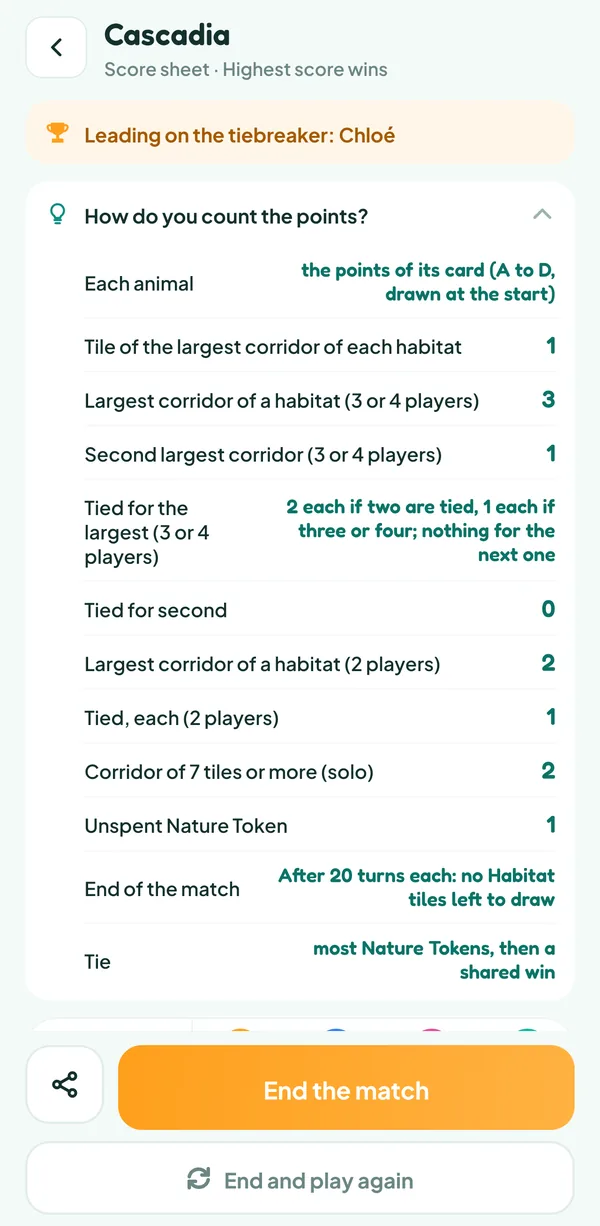
At the end, everyone types their points for each animal and each habitat, their Corridor Majorities and their Nature Tokens: Teamzy keeps the total live. A tie? The "Nature Tokens" tiebreaker line decides it. The "How do you count the points?" help reminds you of the scale.
Cascadia in 30 seconds
Cascadia is a game published by Flatout Games and AEG, for 1 to 4 players. Everyone builds an environment with Habitat tiles and Wildlife tokens. On your turn, you pick one of four pairs, a Habitat tile and a Wildlife token, add the tile next to your environment and place the token on a tile that accepts it. Placing the right animal on certain tiles earns a Nature Token, which you can spend to pick your tile and token freely. The match ends when, at the end of a player's turn, there are no Habitat tiles left to draw: everyone has then played 20 turns. Everyone adds up their animals, their habitats, their Corridor Majorities and their Nature Tokens. The highest total wins.
What animals, habitats and majorities are worth
Cascadia is counted in four steps. First the animals: for each of the five (bears, elk, salmon, hawks, foxes), you score the points of its Wildlife Scoring Card, drawn at random at the start of the match among the A to D cards of that animal. Then the habitats: 1 point per tile of the largest corridor of each of the five habitats (mountains, forests, prairies, wetlands, rivers); tiles belong to the same corridor if they are the same habitat and share a side, so corridors of 3 and 4 forests are worth 4 points. Then the Corridor Majorities, habitat by habitat, from the size of those corridors. With 3 or 4 players: +3 for the largest corridor, +1 for the second; two players tied for the largest score 2 each, three or four score 1 each, and there is no second place; players tied for second score nothing. With 2 players: +2 for the largest corridor, 1 each on a tie. Finally, 1 point per unspent Nature Token. On a tie, whoever has the most Nature Tokens wins; otherwise the victory is shared.
The scale and the end of the match
| What counts | Points |
|---|---|
| Each animal | the points of its card (A to D, drawn at the start) |
| Tile of the largest corridor of each habitat | 1 |
| Largest corridor of a habitat (3 or 4 players) | 3 |
| Second largest corridor (3 or 4 players) | 1 |
| Tied for the largest (3 or 4 players) | 2 each if two are tied, 1 each if three or four; nothing for the next one |
| Tied for second | 0 |
| Largest corridor of a habitat (2 players) | 2 |
| Tied, each (2 players) | 1 |
| Corridor of 7 tiles or more (solo) | 2 |
| Unspent Nature Token | 1 |
| End of the match | After 20 turns each: no Habitat tiles left to draw |
| Tie | most Nature Tokens, then a shared win |
Chloé's environment, line by line
Chloé's environment at the end of the match: 58 points of animals, 23 of habitats, 4 of Corridor Majorities and 3 of Nature Tokens. Each line says where the total you type in Teamzy comes from.
| Line | Detail | Points |
|---|---|---|
| The five animals | Bears 19, elk 9, salmon 8, hawks 11, foxes 11, from her Wildlife Scoring Cards (19 + 9 + 8 + 11 + 11) | 58 |
| The five habitats | Largest corridor: 5 mountains, 4 forests, 5 prairies, 3 wetlands, 6 rivers (5 + 4 + 5 + 3 + 6) | 23 |
| Corridor Majorities | +3 for rivers (corridor of 6) and +1 for mountains (corridor of 5) | 4 |
| Nature Tokens | 3 unspent Nature Tokens | 3 |
| Chloé's total | 88 | |
In Teamzy, you type 19, 9, 8, 11 and 11, then 5, 4, 5, 3 and 6, then 4 and 3 on Chloé's lines. The page does not break down the Wildlife Scoring Cards: they change from one match to the next.
The Corridor Majorities of the example
With four players, each habitat gives +3 to the largest corridor and +1 to the second. Each cell shows the size of the player's largest corridor in that habitat, with their bonus in green. In rivers, Emma and Nathan are tied for second (5 tiles): nobody scores the +1.
| Habitat | Emma | Nathan | Chloé | Lucas |
|---|---|---|---|---|
| Mountains | 6+3 | 4 | 5+1 | 3 |
| Forests | 5 | 7+3 | 4 | 6+1 |
| Prairies | 7+3 | 3 | 5 | 6+1 |
| Wetlands | 4 | 6+3 | 3 | 5+1 |
| Rivers | 5 | 5 | 6+3 | 4 |
| Corridor Majorities | 6 | 6 | 4 | 3 |
In Teamzy, you type everyone's total on the Corridor Majorities line: 6, 6, 4 and 3. The app does not work it out for you.
The sheet of the example
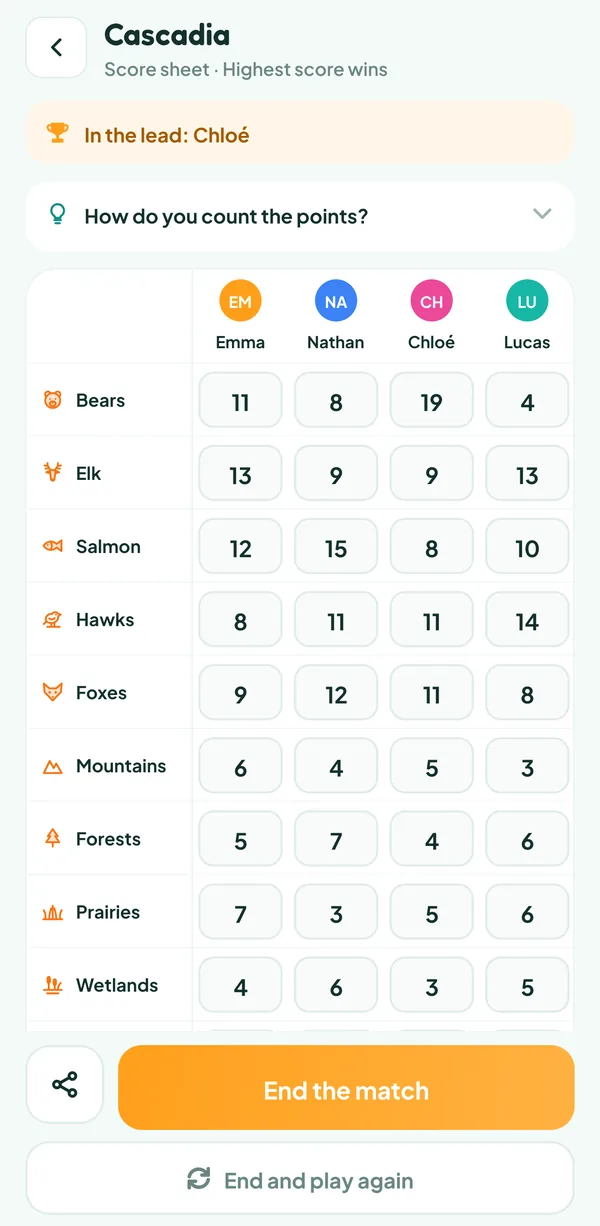
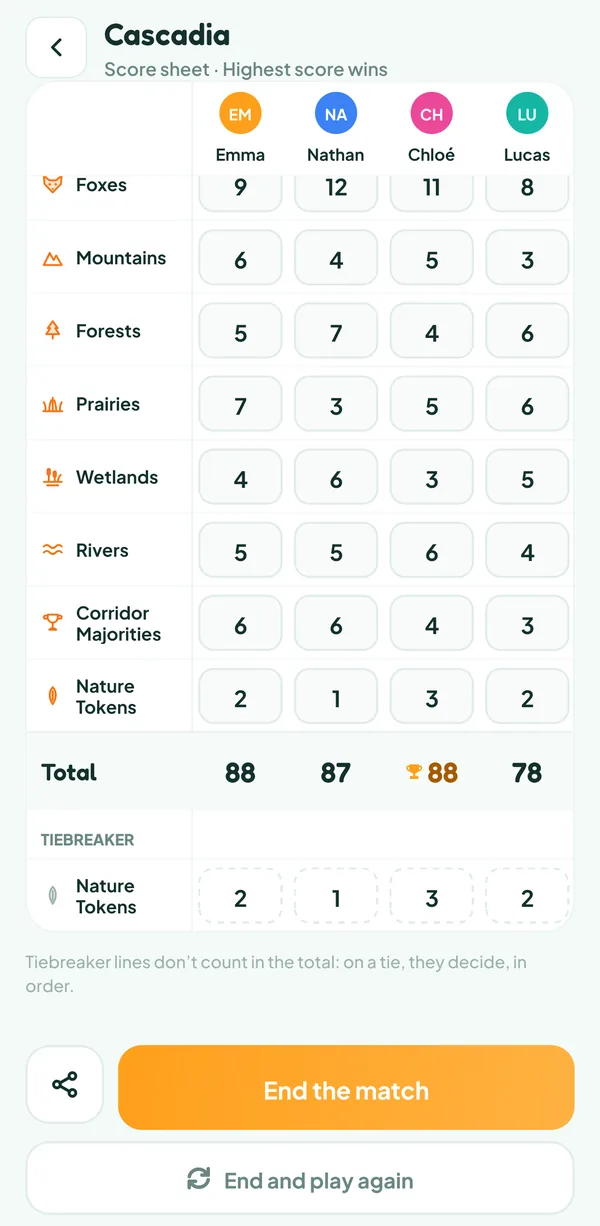
The match told below, noted in Teamzy at the end: one line per category, the live total, then the tiebreaker line. The "Without bonuses or tokens" line is added here for comparison: the app does not have it. Without them, Chloé leads with 81 points; once the Corridor Majorities and the Nature Tokens are added, Emma catches up at 88.
| Emma | Nathan | Chloé | Lucas | |
|---|---|---|---|---|
| Bears | 11 | 8 | 19 | 4 |
| Elk | 13 | 9 | 9 | 13 |
| Salmon | 12 | 15 | 8 | 10 |
| Hawks | 8 | 11 | 11 | 14 |
| Foxes | 9 | 12 | 11 | 8 |
| Mountains | 6 | 4 | 5 | 3 |
| Forests | 5 | 7 | 4 | 6 |
| Prairies | 7 | 3 | 5 | 6 |
| Wetlands | 4 | 6 | 3 | 5 |
| Rivers | 5 | 5 | 6 | 4 |
| Without bonuses or tokens | 80 | 80 | 81 | 73 |
| Corridor Majorities | 6 | 6 | 4 | 3 |
| Nature Tokens | 2 | 1 | 3 | 2 |
| Total | 88 | 87 | 88 | 78 |
| Tiebreaker | ||||
| Nature Tokens | 2 | 1 | 3 | 2 |
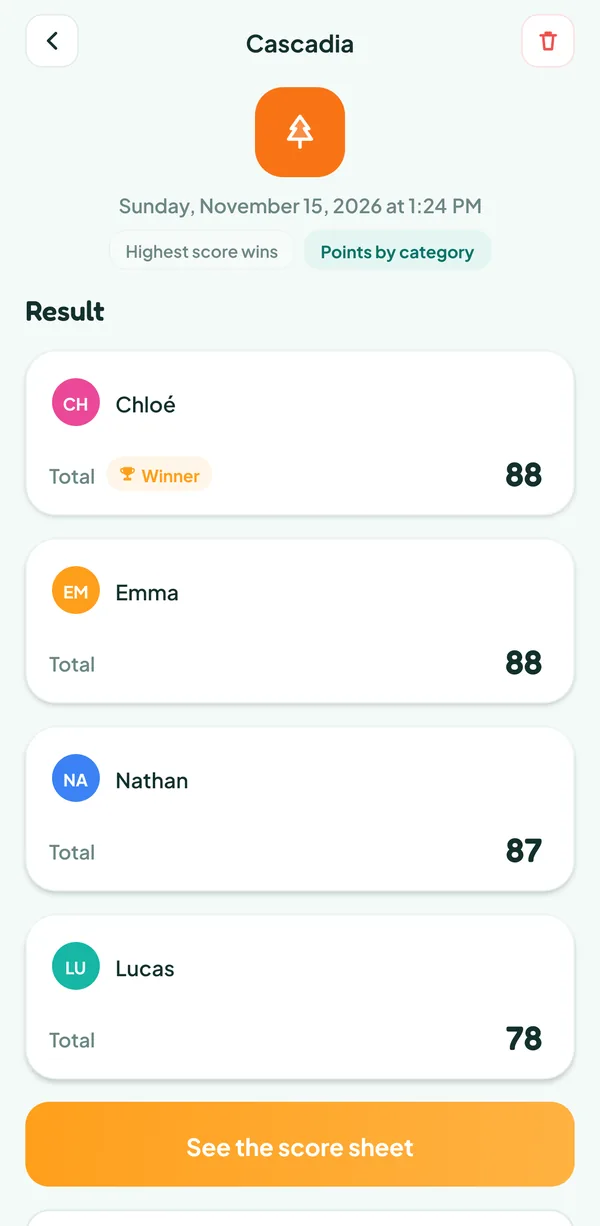
Chloé wins: 88 points like Emma, but 3 Nature Tokens against 2. Nathan finishes third with 87 points, Lucas last with 78.
A match for four, tight down to the Nature Tokens
Emma, Nathan, Chloé and Lucas have just finished a match of Cascadia, with the Wildlife Scoring Cards drawn at the start. Each has their animals, habitats, Corridor Majorities and Nature Tokens to count.
- 1Everyone reads off the points of their five animals on their Wildlife Scoring Cards. Chloé finds 19, 9, 8, 11 and 11, which makes 58 points; Emma has 53, Nathan 55 and Lucas 49.
- 2Then everyone counts the tiles of their largest corridor in each habitat. Chloé has 5, 4, 5, 3 and 6, which makes 23 points; Emma 27, Nathan 25 and Lucas 24. Without the bonuses, Chloé leads with 81 points, ahead of Emma and Nathan (80) and Lucas (73).
- 3Time for the Corridor Majorities, habitat by habitat. Emma takes +3 in mountains and prairies, which makes 6. Nathan takes +3 in forests and wetlands, which makes 6. Chloé takes +3 in rivers and +1 in mountains, which makes 4. Lucas is second in forests, prairies and wetlands: 3. In rivers, Emma and Nathan are tied for second: 0.
- 4Each unspent Nature Token is worth 1 point: 2 for Emma, 1 for Nathan, 3 for Chloé, 2 for Lucas. The totals come in: 88, 87, 88 and 78. Emma and Chloé are tied for the lead, so the Nature Tokens are counted: 2 for Emma, 3 for Chloé.
Chloé wins with 88 points, ahead of Emma (same total, fewer Nature Tokens), Nathan (87) and Lucas (78). Already in front without the bonuses, she wins by one token.
In Teamzy, you type on each line the total of each animal, then the number of tiles of the largest corridor of each habitat, then the Corridor Majorities (6, 6, 4 and 3) and the Nature Tokens (2, 1, 3 and 2). The total works itself out. Under the total, on the Nature Tokens tiebreaker line, you type 2, 1, 3 and 2 again: that line is not added to the points and only matters on a tie. Teamzy shows "Leading on the tiebreaker: Chloé" and keeps the match in the history.
The questions that come up at the table
You add up four things: the points of the five animals from the Wildlife Scoring Cards, 1 point per tile of the largest corridor of each habitat, the Corridor Majorities, and 1 point per unspent Nature Token. The table and the example above show it on a complete environment. In Teamzy, you type one total per line and the app adds it up.
The Cascadia rulebook at AEG, in English (PDF)At the start of the match, one Wildlife Scoring Card is drawn at random for each animal (bear, elk, salmon, hawk, fox), among the A to D versions of each. Each card says how its animal earns points: at the end, you read off the total of each animal. In Teamzy, type it on the animal's line (Bears, Elk, Salmon, Hawks, Foxes). The values change with the cards drawn, so the page does not break them down.
Each habitat (mountains, forests, prairies, wetlands, rivers) earns 1 point per tile of your largest corridor: tiles of the same habitat that share at least one side. With one corridor of 3 forests and another of 4, only the one of 4 counts, which makes 4 points. In Teamzy, type on each line the number of tiles of your largest corridor.
They are worked out habitat by habitat, from the size of the largest corridor of each. With 3 or 4 players: +3 for the largest, +1 for the second; two players tied for the largest score 2 each, three or four score 1 each, and nobody is second; players tied for second score nothing. With 2 players: +2 for the largest, 1 each on a tie. In Teamzy, type the sum of your bonuses on the Corridor Majorities line: the app does not work it out, and the table of the example shows you how.
Each Nature Token you have left at the end is worth 1 point; a spent token earns nothing. Placing the right animal on certain tiles earns one, and you can spend them to pick your tile and token freely. In Teamzy, type the number of tokens you have left on the Nature Tokens line.
When, at the end of a player's turn, there is no Habitat tile left to draw to replace the one they have just taken. Everyone has then played exactly 20 turns, and you count. Teamzy does not watch for the end of the match: you type your totals when your table has finished counting.
Whoever has the most Nature Tokens; if it is still a tie, the victory is shared. In Teamzy, type everyone's number of Nature Tokens on the Nature Tokens tiebreaker line, under the total: it is not added to the points. If everything is equal, the app shows a tie for the lead.
The game is played by 1 to 4 players. In solo, the rulebook gives +2 for each habitat whose largest corridor has 7 tiles or more: Teamzy does not handle that mode, and its sheet counts 2 to 4 players. The family variant, with its own Wildlife Scoring Card, is counted the same way, and players may choose to skip the Corridor Majorities: then leave the line empty. Expansions add their own rules. To add a line of points, open the game's page before the match, tap "Add a category", name it and choose the "Typed" type. At the end, type everyone's points on that line.
Each player has a column and each category a line: you type everyone's points and the total works itself out, with a banner showing who leads. The "How do you count the points?" help reminds you of the scale without leaving the sheet, and you find the match in the history, with its ranking.
Where to find the game
As an Amazon Associate I earn from qualifying purchases.
Your next Cascadia, without pen and paper
Type the total of each animal and each habitat, your Corridor Majorities and your Nature Tokens, let the app add up and break the tie, and find your matches in the history. Free to start, Premium as a one-time purchase, no account and no ads.