Counting points in Carcassonne, from the first tile to the final scoring
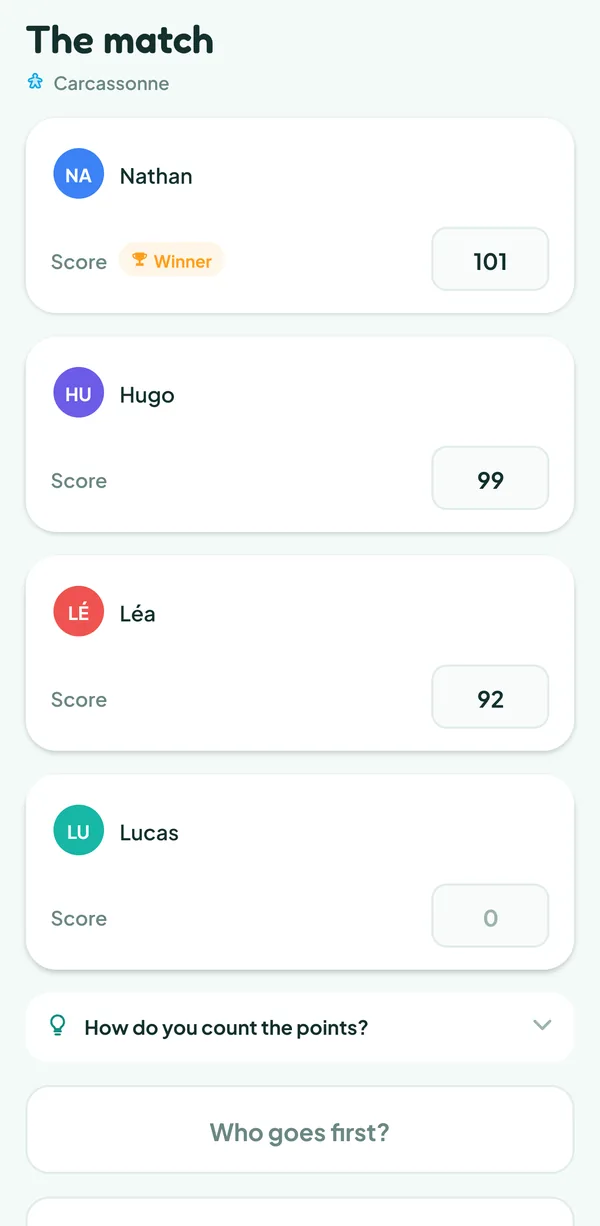
During the match, the score track does the work. At the end, everyone reads their score, laps included, and types it into Teamzy: the app names the winner, keeps the match in the history and keeps your crew's leaderboards.
Carcassonne in 30 seconds
Carcassonne is a tile-laying game by Klaus-Jürgen Wrede, published by Hans im Glück, for 2 to 5 players. On your turn, you draw a tile and place it so it continues the landscape: roads, cities, monasteries and fields. You may then place one of your meeple on that tile, as a thief on a road, a knight in a city, a monk on a monastery or a farmer in a field. As soon as a road, a city or a monastery is finished, it scores for whoever has the most meeple on it, and their scoring meeple moves along the score track. When the last tile is placed, you score what is left unfinished and the fields: the highest total wins.
What scores points
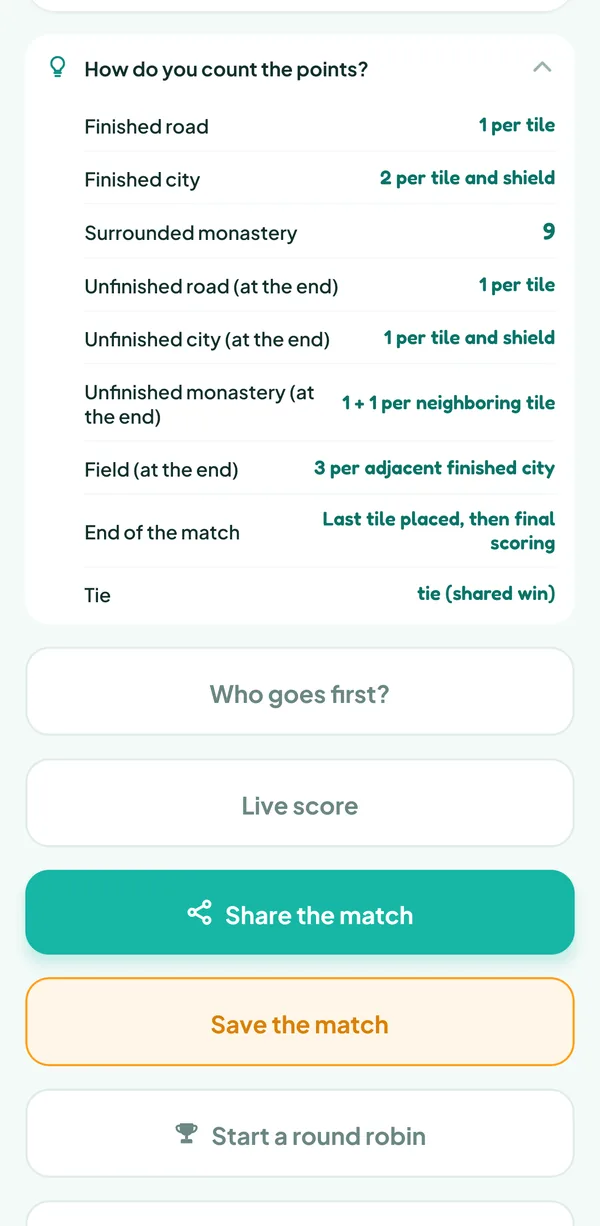
During the match, a finished road is worth 1 point per tile, a finished city 2 points per tile and 2 per shield, a monastery surrounded by its 8 tiles 9 points. At the final scoring, an unfinished road is still worth 1 point per tile, an unfinished city only 1 point per tile and per shield, an unfinished monastery 1 point plus 1 per neighboring tile, and each field 3 points per finished city it touches. On a shared road, city or field, whoever has the most meeple scores it all; if meeple are tied, each of them scores it all.
The points, during the match and at the end
| What counts | Points |
|---|---|
| Finished road | 1 per tile |
| Finished city | 2 per tile and shield |
| Surrounded monastery | 9 |
| Unfinished road (at the end) | 1 per tile |
| Unfinished city (at the end) | 1 per tile and shield |
| Unfinished monastery (at the end) | 1 + 1 per neighboring tile |
| Field (at the end) | 3 per adjacent finished city |
| End of the match | Last tile placed, then final scoring |
| Tie | tie (shared win) |
Nathan's final scoring
When the last tile is placed, Nathan is on 65 on the track, in third place. He still has a thief on a road, a knight in a city and a monk on a monastery, all unfinished, and a farmer alone on the big field in the middle. Here is what each of them scores.
| Still in play | What you count | Points |
|---|---|---|
| Unfinished road | 4 tiles, 1 point each | 4 |
| Unfinished city | 3 tiles and 1 shield, 1 point each | 4 |
| Unfinished monastery | 1 point, plus 6 neighboring tiles | 7 |
| Field | 7 finished cities touched, 3 points each | 21 |
| Nathan's final scoring | 36 | |
The example match, from the track to the final score
On the track, Hugo leads with 78 points when the last tile is placed. The final scoring gives each player between 9 and 36 points: Nathan's fields, 21 points on their own, take him from third to first.
| Nathan | Hugo | Léa | Lucas | |
|---|---|---|---|---|
| On the track, at the last tile | 65 | 78 | 71 | 58 |
| Unfinished roads | 4 | 3 | 2 | 5 |
| Unfinished cities | 4 | 0 | 7 | 2 |
| Unfinished monasteries | 7 | 6 | 0 | 8 |
| Fields | 21 | 12 | 12 | 0 |
| Final scoring | 36 | 21 | 21 | 15 |
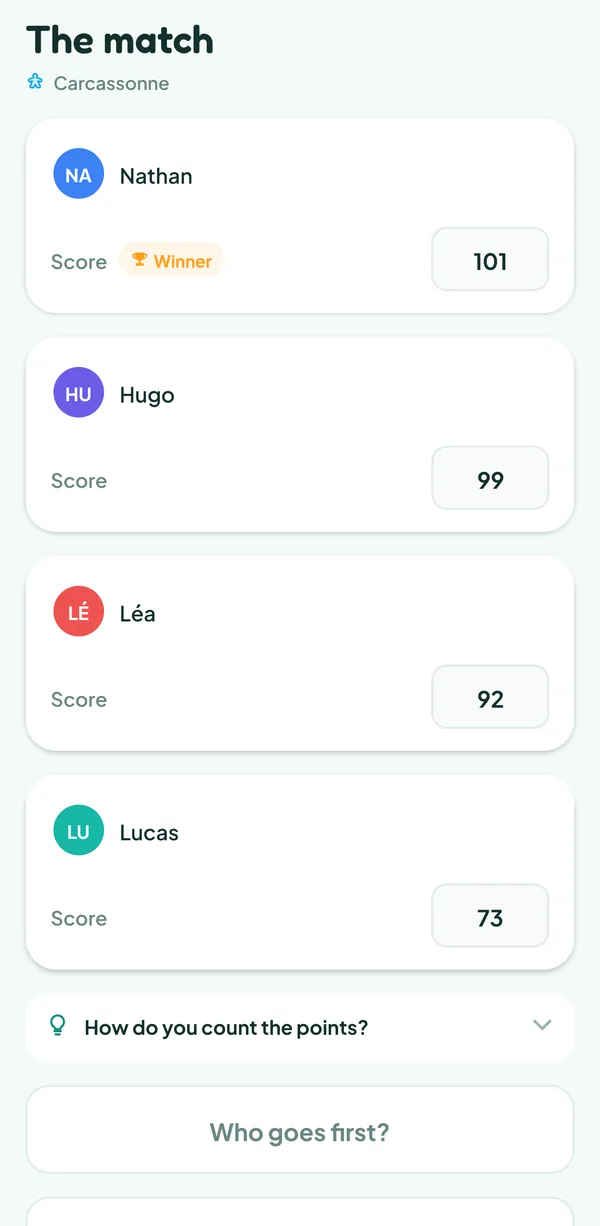
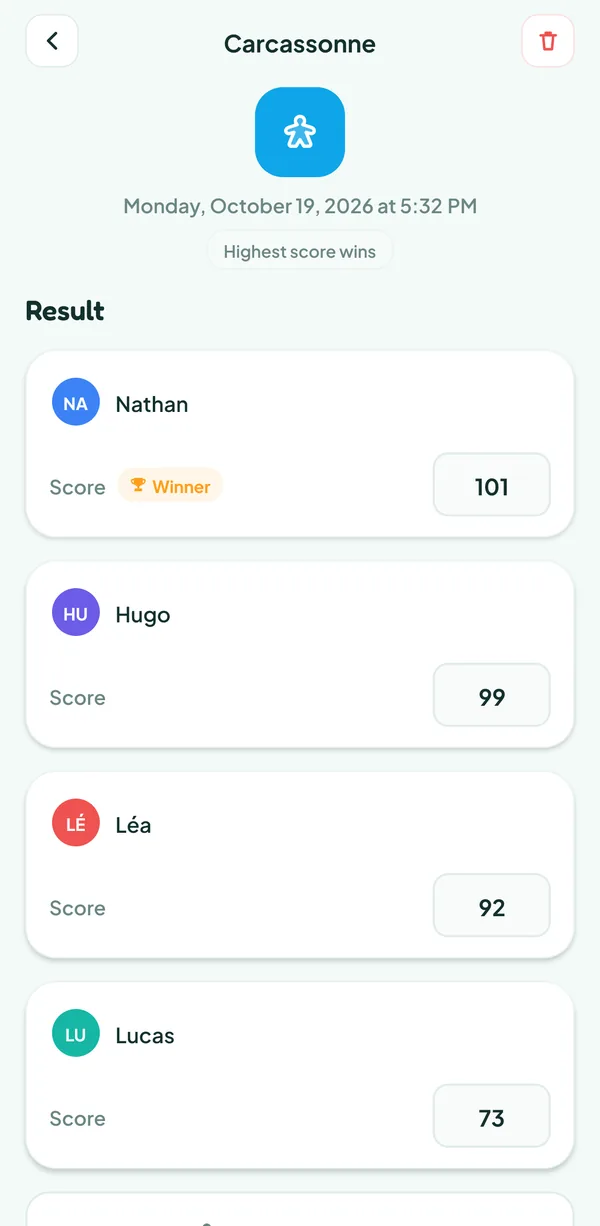
| Final score | 101 | 99 | 92 | 73 |
Nathan wins with 101 points. Hugo, ahead on the track, ends on 99. Léa follows with 92, Lucas with 73.
The score sheet to print
A Carcassonne score sheet in US Letter, for 2 to 5 players: a line to tick the laps of the track beyond 50, the space where your scoring meeple ends, then the final scoring line by line (unfinished roads, cities and monasteries, fields), a free line for the expansions and the final score. At the bottom, the points recalled. Print it for your next match, or type the final score straight into Teamzy.
Download the Carcassonne score sheet (PDF)A match turned around by the fields
Nathan, Hugo, Léa and Lucas play a four-player match, with farmers and fields. Hugo finishes city after city, Léa goes for monasteries, Lucas for roads, and Nathan places a farmer early in the middle of a big field, surrounded by small cities.
- 1During the match, Hugo finishes a city of 5 tiles with 2 shields: 14 points, 10 for the tiles and 4 for the shields. Léa surrounds her monastery with its 8 tiles, 9 points. Nathan and Lucas each have a thief on the same road of 6 tiles: when it is finished, they score 6 points each.
- 2The last tile is placed. On the track, Hugo is on 78 (his meeple has gone round once, lying on space 28), Léa on 71, Nathan on 65 and Lucas on 58. The final scoring is still to come.
- 3First, what is unfinished. Nathan scores 15 points: 4 for his road, 4 for his city of 3 tiles and 1 shield, 7 for his monastery with 6 tiles around it. Lucas also scores 15, Hugo and Léa 9 each. Hugo moves to 87, Léa and Nathan to 80, Lucas to 73.
- 4Then the fields. Nathan is alone on the big field in the middle, which touches 7 finished cities: 21 points. Hugo and Léa each have a farmer on a field that touches 4 finished cities: their meeple are tied, so they score 12 points each. Lucas has no farmer.
Nathan wins with 101 points. Hugo, ahead on the track, ends on 99: he is 2 points short. Léa follows with 92, Lucas with 73.
In Teamzy, there is nothing to note during the match: the track takes care of it. At the end, everyone reads their score on the track, laps included, and types it under their name: 101 for Nathan, 99 for Hugo, 92 for Léa and 73 for Lucas. Below the scores, the "How do you count the points?" help recalls the final scoring. Teamzy names the winner, keeps the match in the history and counts it in the leaderboards.
The questions that come up at the table
Points are scored all match long, on the score track: as soon as a road, a city or a monastery is finished, whoever has the most meeple on it scores and takes their meeple back. When the last tile is placed, you add the final scoring: unfinished roads, cities and monasteries, then the fields. The highest total wins. In Teamzy, everyone then types their final score, read on the track.
The Carcassonne rules on the Hans im Glück websiteA finished city, fully closed by its walls, scores 2 points per tile and 2 points per shield. A city of 3 tiles with 1 shield is worth 8 points. If it is still open at the end of the match, it scores only half: 1 point per tile and per shield. In older editions, a finished city of only 2 tiles was worth just 2 points; in the current rules, it is worth 4, like any other.
Fields score nothing during the match: farmers stay lying down until the end. At the final scoring, each field scores 3 points per finished city it touches, whatever its size, for whoever has the most farmers on it. An unfinished city does not count, and the same city can count for several fields. The current Hans im Glück rules score 3 points per city and per field.
The score track stops at 50: when your scoring meeple reaches or passes space 50, it starts again from 0. The rules suggest noting it or laying your meeple down: a meeple lying down is worth 50 points plus its space. On a second lap, write it down, or use the "Laps of the track" line of the score sheet to print. A meeple lying on space 28 means 78 points.
Both of them. On a shared road, city or field, whoever has the most meeple scores all the points; if several players are tied, each of them scores all the points. The others score nothing. That is what happens to Hugo and Léa in the example: one farmer each on the same field, 12 points each.
The Carcassonne rules have no tiebreaker: if players have the same points after the final scoring, they share the win. Teamzy does the same: two equal final scores at the top make a tie, a shared win.
Because the score track already holds the total all match long: copying out every road and every city would be pointless. Teamzy takes over at the end. You type everyone's final score, and the app names the winner, keeps the match in the history, counts it in the leaderboards and notes everyone's records. Below the scores, the "How do you count the points?" help recalls the final scoring, so you forget nothing before typing.
The river, its 12 tiles placed first, changes the start of the match but not the points. With the abbot, a surrounded monastery or garden scores 9 points, like a monastery; you can also take your abbot back early, instead of placing a meeple, and score the tiles around it, its own included, right away. In Inns & Cathedrals, a road with an inn scores 2 points per tile and a city with a cathedral 3 per tile and per shield, but nothing if they are still unfinished at the end; the large meeple counts as two. In Traders & Builders, whoever has the most tokens of each good scores 10 points at the end. All of these points move along the same track: in Teamzy, the final score you type already includes them.
Your next Carcassonne match, kept for good
Read everyone's final score on the track, type it in, and find your matches in the history and your crew's leaderboards. Free to start, Premium as a one-time purchase, no account and no ads.