Keeping score in Dixit, from the storyteller to the votes
At the end of each turn, you type everyone's points: Teamzy adds up the totals, ranks the players and ends the match as soon as someone reaches 30 points. While you type, the “How do you count the points?” help reminds you what the storyteller, the players who find their card and each vote received are worth.
Dixit in 30 seconds
Dixit is a party game by Jean-Louis Roubira, illustrated by Marie Cardouat and published by Libellud, for 3 to 8 players. Each turn, one player is the storyteller: they pick a card from their hand and give a clue, a word, a sentence, even a song. Each of the others hands over the card from their hand that best fits the clue, the storyteller shuffles them and lays them out, then everyone secretly votes for the one they think is the storyteller's. The storyteller scores if some players find their card, but not all; the others score by finding it and by drawing votes to their own card. The match ends at the end of the turn in which a player reaches 30 points, and the highest score wins.
What everyone scores
Once everyone has voted, the storyteller reveals their card and counts the votes. If some players found it, but not all, the storyteller scores 3 points, and so does each player who found it. If everyone found it, or no one did, the storyteller scores nothing and each of the others scores 2 points. In every case, each player except the storyteller also scores 1 point for each vote on their own card. Nobody votes for their own card.
The points of a turn
| What counts | Points |
|---|---|
| Storyteller, if some find their card | 3 |
| Player who finds the storyteller’s card | 3 |
| Everyone or no one finds it | storyteller 0, others 2 |
| Vote received on your card | 1 |
| End of the match | At 30 points |
One turn worked out, vote by vote
The last turn of the match told below. Hugo is the storyteller and no one finds his card: he scores 0, each of the others scores 2, plus 1 point for each vote on their own card.
| Player | Voted for | Everyone or no one | Votes received | Points |
|---|---|---|---|---|
| LéaDraws Chloé's vote | Emma | 2 | + 1 | 3 |
| HugoStoryteller, 28 points before this turn | storyteller, does not vote | 0 | 0 | 0 |
| EmmaDraws the votes of Léa and Lucas | Lucas | 2 | + 2 | 4 |
| LucasDraws Emma's vote | Emma | 2 | + 1 | 3 |
| ChloéNo vote on her card | Léa | 2 | + 0 | 2 |
The score sheet of the example
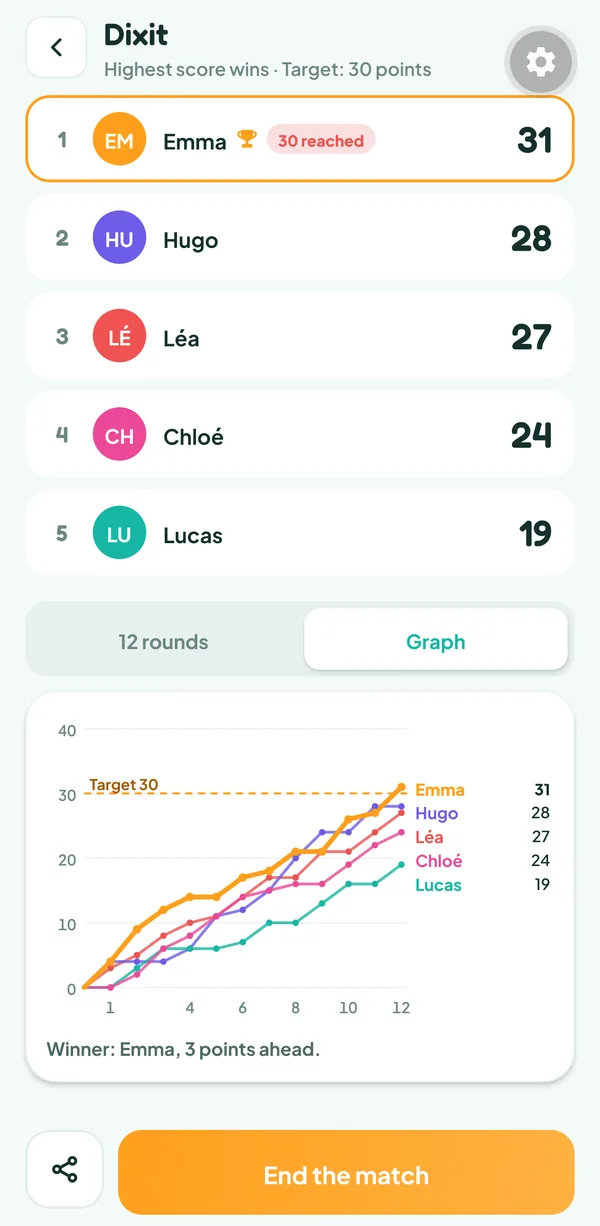
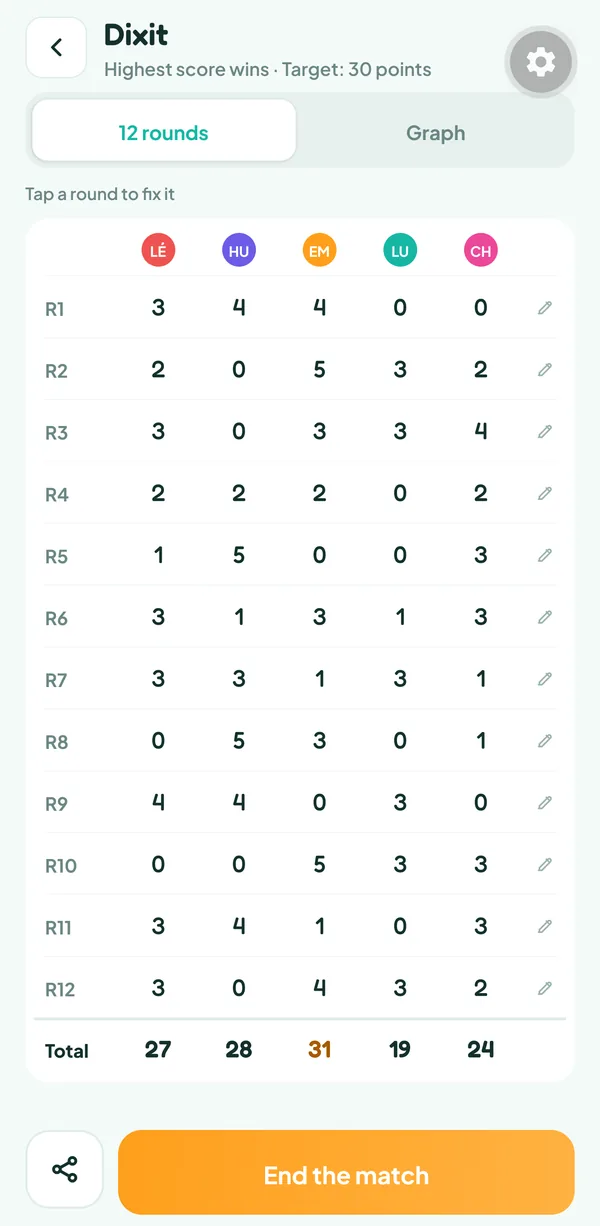
The twelve turns of the match told below, with everyone's points as you write them down. The dot ● marks the storyteller of the turn: 3 when some found their card, 0 when everyone found it (turn 4) or no one did (turns 2 and 12). Hugo leads after the 11th turn; in the 12th, Emma goes from 27 to 31 and the match ends.
| Turn | Léa | Hugo | Emma | Lucas | Chloé |
|---|---|---|---|---|---|
| 1 | 3 (Storyteller of the turn) | 4 | 4 | 0 | 0 |
| 2 | 2 | 0 (Storyteller of the turn)no one | 5 | 3 | 2 |
| 3 | 3 | 0 | 3 (Storyteller of the turn) | 3 | 4 |
| 4 | 2 | 2 | 2 | 0 (Storyteller of the turn)everyone | 2 |
| 5 | 1 | 5 | 0 | 0 | 3 (Storyteller of the turn) |
| 6 | 3 (Storyteller of the turn) | 1 | 3 | 1 | 3 |
| 7 | 3 | 3 (Storyteller of the turn) | 1 | 3 | 1 |
| 8 | 0 | 5 | 3 (Storyteller of the turn) | 0 | 1 |
| 9 | 4 | 4 | 0 | 3 (Storyteller of the turn) | 0 |
| 10 | 0 | 0 | 5 | 3 | 3 (Storyteller of the turn) |
| 11 | 3 (Storyteller of the turn) | 4 | 1 | 0 | 3 |
| After 11 turns | 24 | 28 (in the lead) | 27 | 16 | 22 |
| 12 | 3 | 0 (Storyteller of the turn)no one | 4 | 3 | 2 |
| Total | 27 | 28 | 31 (30 points reached) | 19 | 24 |
The last turn of a five-player match
Léa, Hugo, Emma, Lucas and Chloé are playing Dixit, each one storyteller in turn. After 11 turns, Hugo leads with 28 points, ahead of Emma (27), Léa (24), Chloé (22) and Lucas (16). Nobody has reached 30 yet: the match goes on.
- 1Turn 12. Hugo is the storyteller, and he needs only 2 more points. He picks a card from his hand and gives a very personal clue. Each of the others hands him the card from their hand that best fits the clue, and Hugo lays out the five cards.
- 2Everyone votes in secret. Léa and Lucas vote for Emma's card, Emma for Lucas's, Chloé for Léa's. No one votes for Hugo's card.
- 3No one found his card: Hugo scores 0 and each of the others scores 2. Then comes 1 point for each vote received: 2 for Emma, 1 for Léa, 1 for Lucas, none for Chloé.
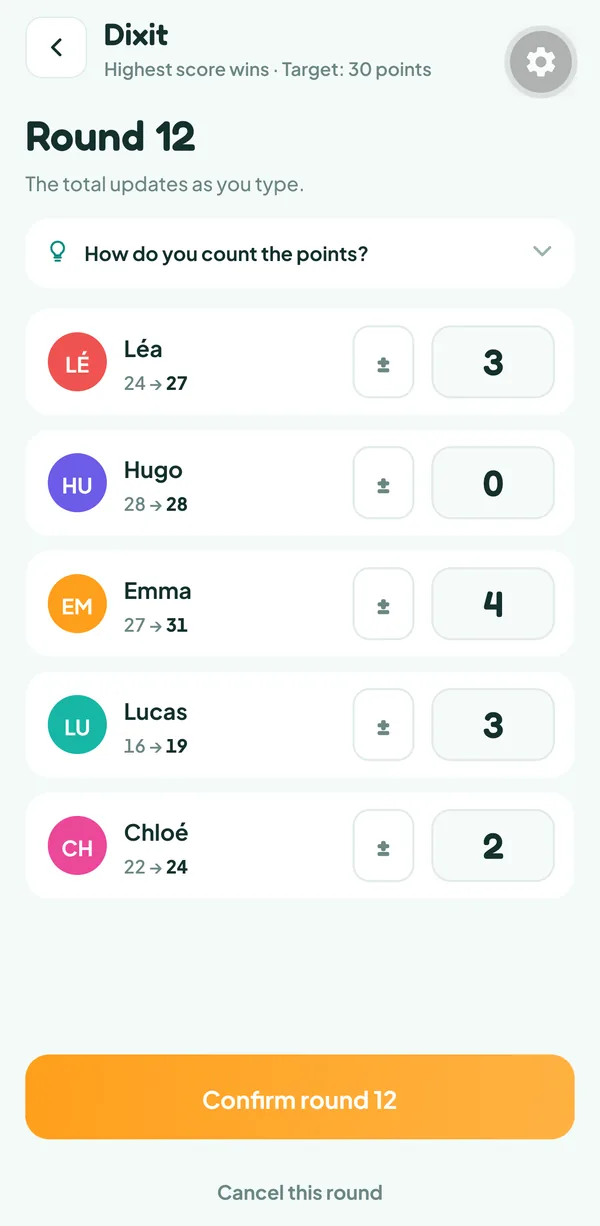
- 4Emma scores 4 and goes from 27 to 31. Léa scores 3 (27), Lucas 3 (19) and Chloé 2 (24); Hugo stays at 28. Emma has reached 30: the match ends at the end of this turn.
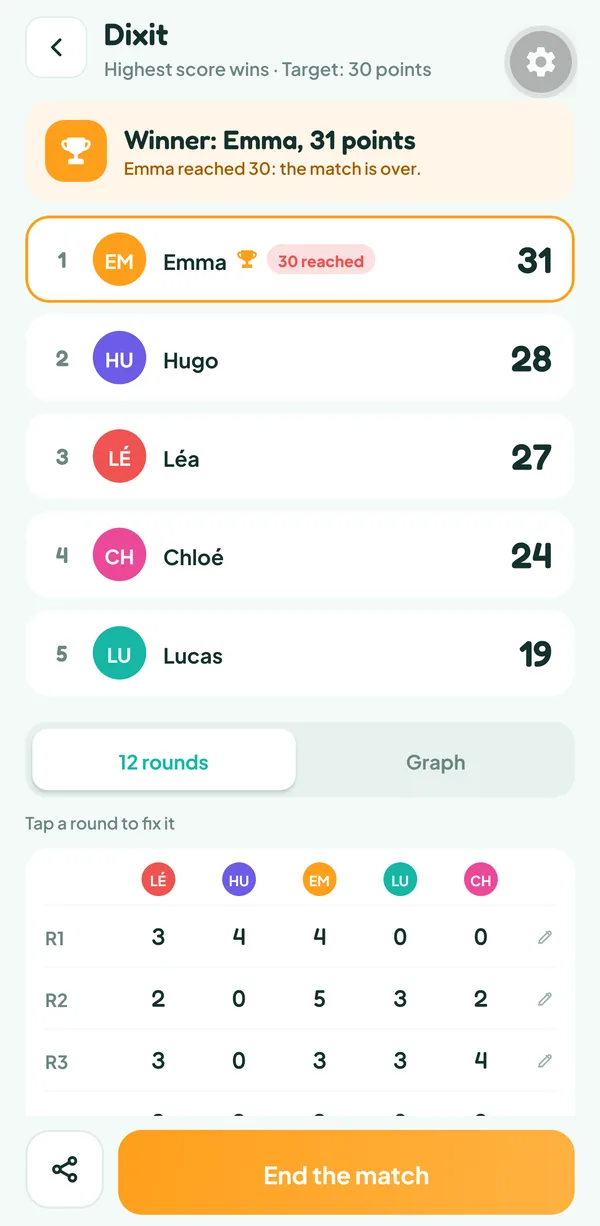
Emma wins with 31 points, ahead of Hugo (28), Léa (27), Chloé (24) and Lucas (19).
In Teamzy, each turn is a round: you type everyone's points at the end of the turn, 3 for Léa, 0 for Hugo, 4 for Emma, 3 for Lucas and 2 for Chloé. While you type, the “How do you count the points?” help reminds you what each case is worth. The app adds up the totals, ranks the players and ends the match as soon as someone reaches 30 points.
The questions that come up at the table
3 points for the storyteller and for each player who finds their card when some find it, but not all; 0 for the storyteller and 2 for each of the others when everyone finds it, or no one does. Each player except the storyteller adds 1 point for each vote on their own card. The details are in the table above. In the example, Emma scores 2 + 2, so 4 points, in the last turn.
The Dixit rulebook from Libellud (PDF)Because the clue was too easy; and when no one finds it, the clue was too hard. That is the whole art of the storyteller: a clue clear enough for some to find the card, vague enough that not everyone does. In both cases, each of the others scores 2 points, plus the votes they received. In the example, no one finds Hugo's card in the last turn: he stays at 28 and Emma moves ahead.
No: the votes on their card only decide whether they score 3 or 0. The point for each vote received goes to the other players, whose card drew someone who was looking for the storyteller's. It adds to everything else: a player who finds the storyteller's card and gets two votes on their own scores 3 + 2, so 5 points.
No, never. Everyone secretly votes for a single card among the others' cards, and all the votes are revealed at the same time. The storyteller does not vote.
At the end of the turn in which a player reaches or passes 30 points. The turn is scored in full, then the highest score wins. In Teamzy, the goal is 30 points: the app ends the match in the round where a player reaches them, like Emma with 31 in the example.
The highest score wins. If several players finish tied in the lead, they share the victory: the rulebook has no tiebreaker.
Everyone holds 7 cards instead of 6, and the two players who are not the storyteller each put down 2 cards instead of 1: 5 cards are laid out, the storyteller's included. The scoring does not change, and a player still scores 1 point for each vote received, on either of their cards. In Teamzy, you type everyone's points just as with more players.
No: the expansions bring new cards, and the points are counted the same way. In Teamzy, there is nothing to set: you type everyone's points as usual.
Your Dixit matches, scored and kept
Type everyone's points at the end of the turn, let the app add up the totals, rank the players and end the match at 30, and find your matches again in the history. Free to start, Premium as a one-time purchase, no account and no ads.