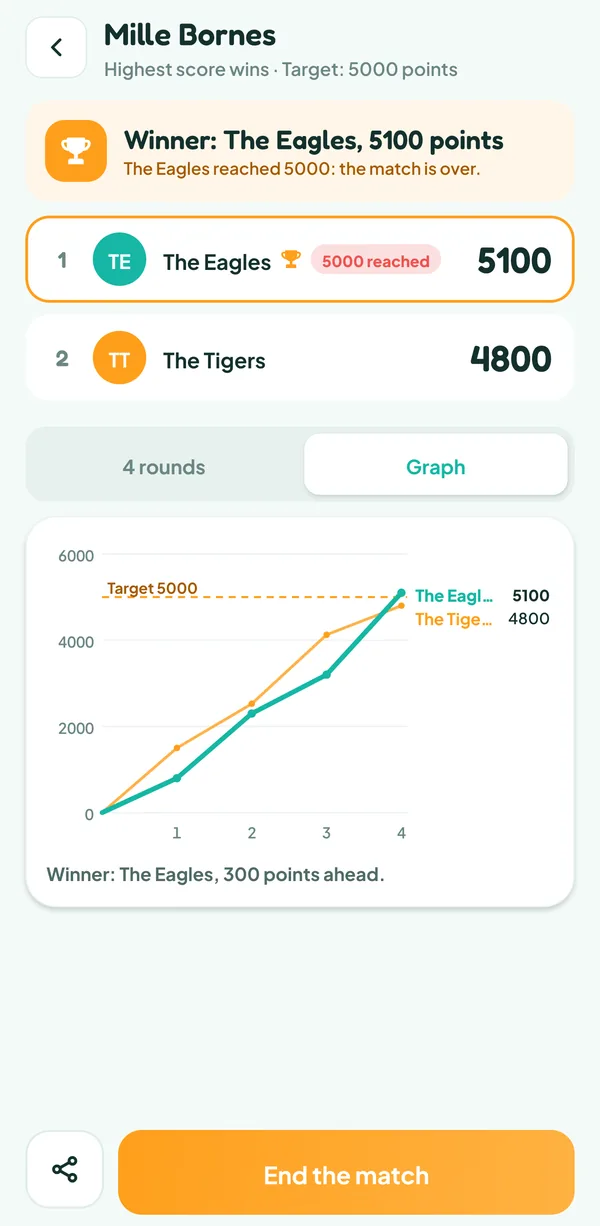
Keep score in Mille Bornes, all the way to 5,000
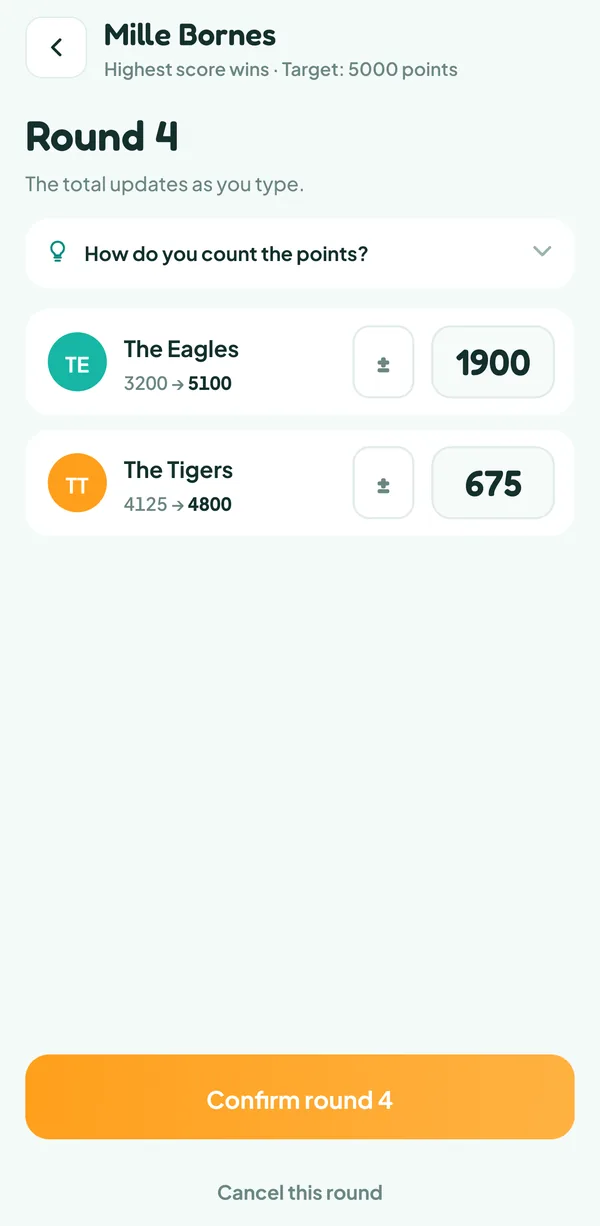
At the end of each round, you type each team's points: Teamzy adds up the totals, charts the race between the teams and ends the match as soon as one of them reaches 5,000. While you type, the “How do you count the points?” help reminds you what everything is worth.
Mille Bornes in 30 seconds
Mille Bornes is a French card game created in 1954 by Edmond Dujardin: a car race where you have to travel exactly 1,000 kilometers. It is often played by four, in two teams of two. On your turn, you draw a card, then play one or discard one: a distance card (25, 50, 75, 100 or 200 kilometers) to move ahead, a hazard (Stop, Speed Limit, Out of Gas, Flat Tire, Accident) to slow the other team down, a remedy to get going again, or a safety that protects you from a hazard until the end of the round. When a team reaches exactly 1,000 kilometers, the round ends: each team scores its kilometers and its bonuses, and the first to 5,000 points wins the match. Dujardin's 2025 box no longer keeps score: the first to reach 1,000 wins.
What a round is worth
The round ends when a team has traveled exactly 1,000 kilometers, or when nobody can play anymore. Each team then counts what is laid in front of it: one point per kilometer, 100 points per safety, 300 more if it laid all 4 safeties, and 300 more for each safety played as a coup fourré. Safeties still in hand count for nothing. The team that completed the trip adds 400 points, and a team scores 500 more if the other one traveled no distance at all: that's the shutout. Points add up from round to round, and the first team to 5,000 points wins the match.
The points of a round
| What counts | Points |
|---|---|
| Each kilometer | 1 |
| Each safety | 100 |
| All 4 safeties, extra | 300 |
| Coup fourré, extra | 300 |
| Trip completed | 400 |
| Shutout (no distance for the others) | 500 |
One round worked out: 1,900 points for the Eagles
The last round of the match told below. The Eagles complete the trip with two safeties, one of them played as a coup fourré; the Tigers stop at 575 kilometers, with one safety.
| What counts | The Eagles | The Tigers |
|---|---|---|
| Kilometers | 1,000
| 575
|
| Safeties, 100 each | 200
| 100
|
| Coup fourré, 300 more | 300
| 0 |
| Trip completed | 400 | 0 |
| Round total | 1,900 | 675 |
The example's score sheet
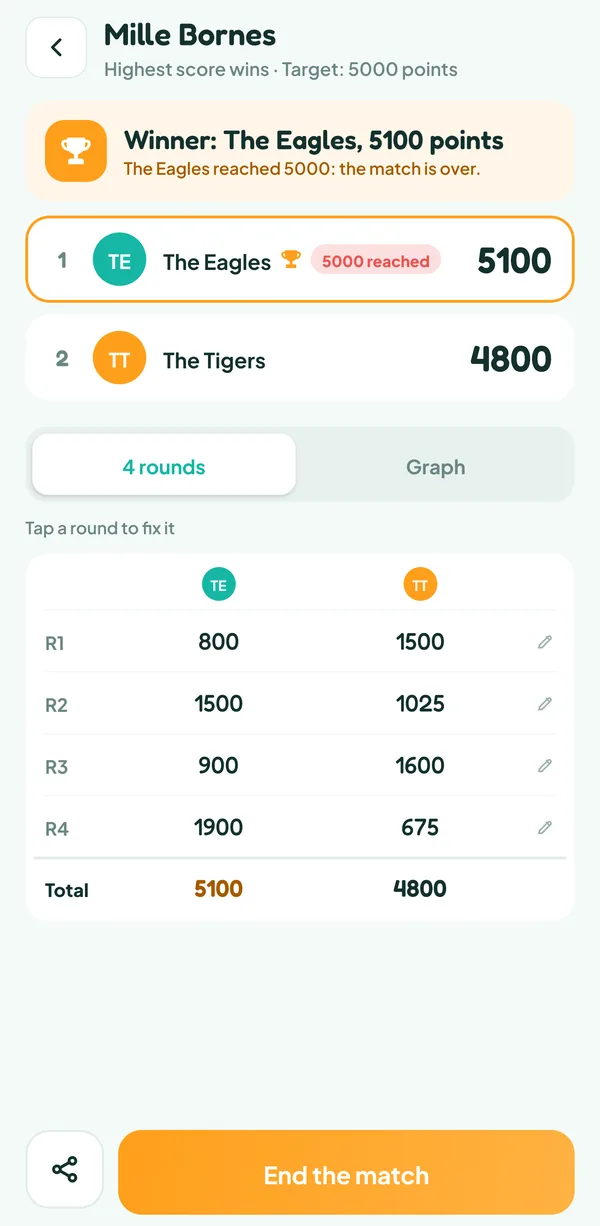
The four rounds of the match told below: each team's points, then its score. The Tigers lead after each of the first three rounds; the Eagles take the lead in the last one and pass 5,000 points.
| Round | The Eagles | The Tigers |
|---|---|---|
| 1 | +800800 | +1,5001,500 (Trip completed, exactly 1,000 kilometers) |
| 2 | +1,5002,300 (Trip completed, exactly 1,000 kilometers) | +1,0252,525 |
| 3 | +9003,200 | +1,6004,125 (Trip completed, exactly 1,000 kilometers) |
| 4 | +1,9005,100 (Trip completed, exactly 1,000 kilometers) | +6754,800 |
| Final score | 5,100 | 4,800 |
The score sheet to print
A Mille Bornes score sheet in US Letter, for 2 or 3 teams (or players) and 8 rounds: for each round, each team's kilometers, safeties, coups fourrés and bonuses, the round total, then the score. The scoring is recapped at the bottom. Print it for your next match, or let Teamzy keep score.
Download the Mille Bornes score sheet (PDF)A whole match in two teams, all the way to 5,000 points
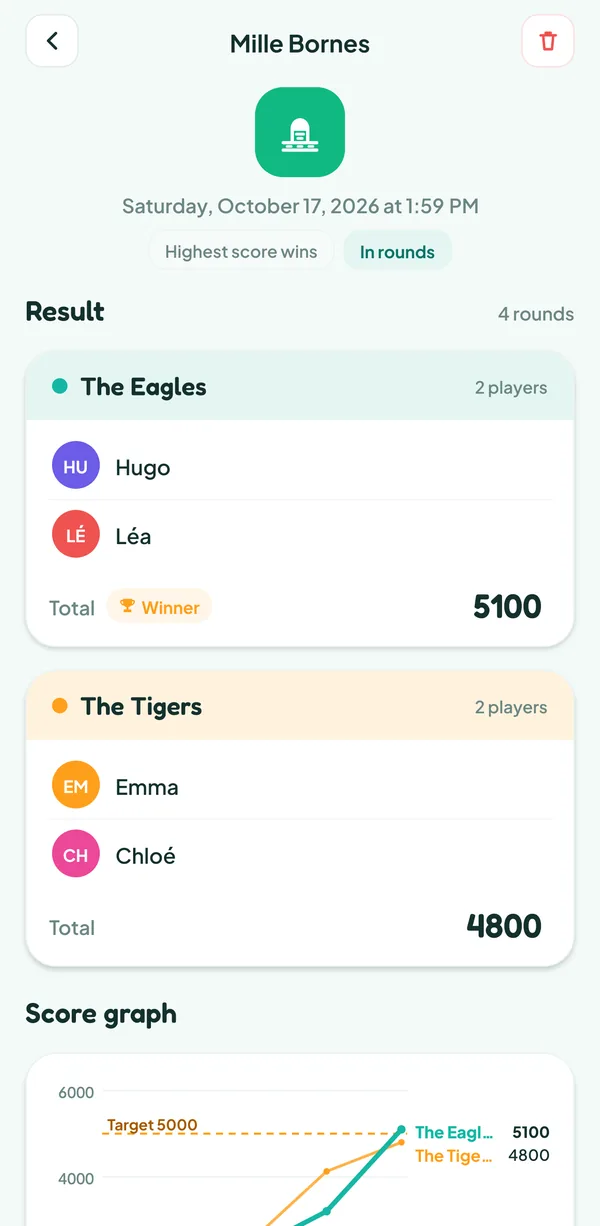
Léa and Hugo (the Eagles) take on Emma and Chloé (the Tigers). The trip is 1,000 kilometers, and they keep score from round to round: it takes them four rounds to reach 5,000.
- 1Round 1: the Tigers complete the trip. They score 1,000 for their kilometers, 400 for the trip completed and 100 for the Driving Ace, so 1,500. The Eagles stopped at 700 kilometers, with the Extra Tank: 800.
- 2Round 2: the Eagles complete the trip in turn, with the Puncture Proof: 1,000 + 400 + 100, so 1,500. The Tigers pull off a coup fourré: when the Eagles play a Stop on them, Emma instantly lays down the Right of Way. With 625 kilometers, they score 625 + 100 + 300, so 1,025. The Tigers lead 2,525 to 2,300.
- 3Round 3: the Tigers complete the trip again, with the Driving Ace and the Extra Tank: 1,000 + 400 + 200, so 1,600. The Eagles travel 900 kilometers, without a safety. The Tigers lead 4,125 to 3,200: they are only 875 points away.
- 4Round 4: the Tigers play a Flat Tire on the Eagles. Léa has the Puncture Proof in hand: “Coup fourré!” She lays it sideways, draws and plays again. Hugo then lays the Right of Way, the Eagles move on to 975 kilometers, and a 25 takes them to exactly 1,000. They score 1,000 + 200 for the two safeties + 300 for the coup fourré + 400 for the trip completed, so 1,900. The Tigers have 575 kilometers and the Extra Tank: 675.
- 5The Eagles go from 3,200 to 5,100 points, the Tigers from 4,125 to 4,800: the Eagles pass 5,000 points, and the match ends at the end of this round.
The Eagles win with 5,100 points, against 4,800 for the Tigers.
In Teamzy, at the end of each round, you type each team's total: 1,900 for the Eagles and 675 for the Tigers in the last one. While you type, the “How do you count the points?” help reminds you what everything is worth. The app adds up the totals, charts the race between the two teams and ends the match as soon as a team reaches 5,000.
The questions that come up at the table
At the end of each round, each team scores one point per kilometer laid in front of it, 100 points per safety laid, 300 more if it has all 4 safeties, and 300 more per coup fourré. The team that completed the trip, exactly 1,000 kilometers, adds 400 points, and a team scores 500 more if the other one traveled no distance at all (the shutout). Points add up from round to round: the first team to 5,000 wins. In the example, the Eagles score 1,900 points in the last round and finish on 5,100.
When an opponent plays a hazard on you and you hold the safety that matches it, you can lay it down at once, even if it's not your turn, calling “Coup fourré!”. The hazard is canceled, you lay the safety sideways so everyone can tell, you draw to fill your hand, then you draw again and play: the players seated between the attacker and you lose their turn. When you count, the safety is worth 100 points and the coup fourré 300 more, so 400. A safety laid on your own turn is only worth 100.
Yes: the trip ends at exactly 1,000 kilometers, and you can't play a distance card that would take you past it. At 950 kilometers, for example, the 75, 100 and 200 are useless: you need a 50, or two 25s. A team can't play more than two 200s in a round, and under a Speed Limit, only 25s and 50s are allowed. In the example, the Eagles have already played their two 200s and finish with a 25, from 975 to 1,000.
Everyone keeps playing the cards in their hand until nobody can play anymore. If a team still reaches 1,000, it scores the trip completed; otherwise, nobody scores those 400 points, and each team counts its kilometers and safeties. Rulebooks differ here: Dujardin's 2024 rules give the round, and the winner's 400 points, to whoever traveled the farthest; the 2025 rules stop the race as soon as the draw pile has no distance cards left, and the closest to 1,000 wins. Agree on it with your table before you start.
In the classic rules, with two or three players, or with six in three teams of two, the trip is only 700 kilometers. Whoever gets there first can end the round, or call an extension: the trip goes up to 1,000 kilometers, and whoever called the extension scores 200 more points if they reach 1,000 first. Dujardin's recent rulebooks no longer mention it. Teamzy's help doesn't count it: if you play it, add its 200 points to the round total you type.
No. Teamzy follows the classic scoring, the one in the table above. Many older rules add 300 points for a trip completed without a 200 card (the safe trip), and 300 for a trip completed after the draw pile is empty (the delayed action). Dujardin's 2024 rulebook, which offers scoring up to 5,000 as a variant, gives nothing for all 4 safeties, 400 points to the winner of the round, 200 for a win without a 200, and 500 to all the others when a player laid no distance card. In the classic rules, the 500-point shutout only goes to the team that completes the trip before the other has laid a single distance card. Pick your rules before you start; in Teamzy, add those bonuses to the round total you type.
Dujardin's 2024 Mille Bornes rules, with the scoring (in French, PDF)No: in the 2025 rulebook, the first to reach exactly 1,000 wins, with no scoring. If the draw pile runs out of distance cards first, the closest to 1,000 wins. A coup fourré earns no points there: it cancels the hazard and lets you draw and play again. For a real match over several rounds, keep score as shown here, up to 5,000: Teamzy keeps every round and ends the match at the right moment.
Dujardin's 2025 Mille Bornes rules (in French, PDF)The classic rules are for four, in two teams of two; with two or three, each player plays alone, and with six, in three teams of two. Dujardin's recent rulebooks have everyone play alone from 2 to 4 players, and in teams of two up to 8. In Teamzy, Mille Bornes is played by 2 to 6 players, in two teams by default: you can change the number of teams in the game's settings, and the app draws the teams for you.
Your next Mille Bornes match, without pen and paper
Draw the teams, type each team's points at the end of the round, let the app add up the totals all the way to 5,000 and find your matches in the history. Free to start, Premium as a one-time purchase, no account and no ads.