Scoring the Categories game, round after round
After each round, you type everyone's total: Teamzy adds it up, shows who is leading and names the winner when you decide to stop. And to play, a game sheet to print.
Categories in 30 seconds
Categories is a word game played with a sheet of paper and a pencil per player, known around the world as Stop, Stadt Land Fluss or Petit bac. You pick some categories (country, city, first name, animal…), draw a letter, and everyone fills in their sheet with words starting with that letter. The first one to fill every box shouts “Stop!”: everyone puts their pencil down, and the answers are compared category by category. An answer nobody else found is worth more than a shared one. You play as many rounds as the table agreed on, and the highest total wins.
What each answer is worth
Everyone reads out their answers, category by category. The simplest scale: 2 points for an answer nobody else has, 1 point for an answer another player also has (1 for each of those who have it), 0 for an empty box or a word the table refuses. Everyone adds up their line, and the totals add up from round to round. Some tables count 20 / 10 / 5 or 10 / 5 / 0: a unique answer is always worth more than a shared one.
The points of a round and the end of the match
| What counts | Points |
|---|---|
| Answer nobody else gave | 2 |
| Answer another player also gave | 1 |
| Empty box or refused word | 0 |
| Other common scales | 20 / 10 / 5 or 10 / 5 / 0 |
| End of the match | after the rounds agreed on |
| Same total at the end | one more round decides, otherwise a tie |
The last round, box by box
Round 5 of the match told below: letter P, six categories. Each box shows the answer and its points. Paris, written three times, gives 1 point to each of the three; Panda, written by Lucas and Chloé, 1 point each; Pegasus, refused by the table, gives nothing.
| Category | Emma | Lucas | Chloé | Nathan |
|---|---|---|---|---|
| Country | Portugal1 | Portugal1 | Peru2 | Poland2 |
| City | Paris1 | Paris1 | Prague2 | Paris1 |
| First name | Paula2 | empty0 | Peter2 | Patrick2 |
| Animal | Penguin2 | Panda1 | Panda1 | Pegasus0refused |
| Job | Pilot1 | Pilot1 | Psychologist2 | Police officer2 |
| Fruit or vegetable | Papaya2 | Pepper2 | Parsnip2 | Peach2 |
| Total of the round | 9 | 6 | 11 | 9 |
The example's score sheet
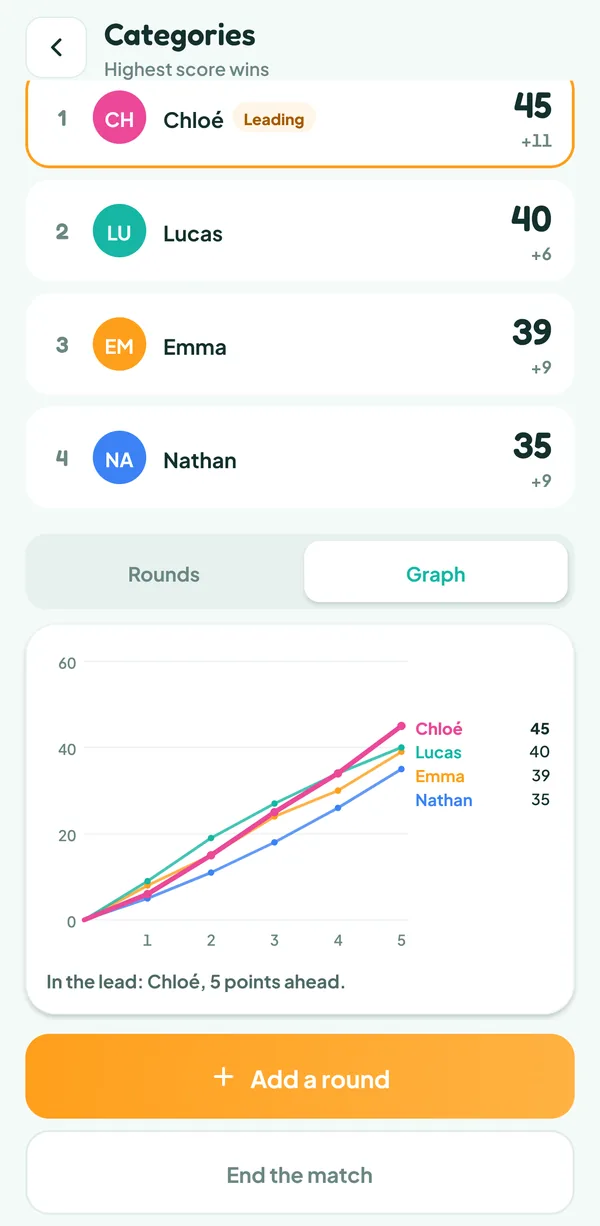
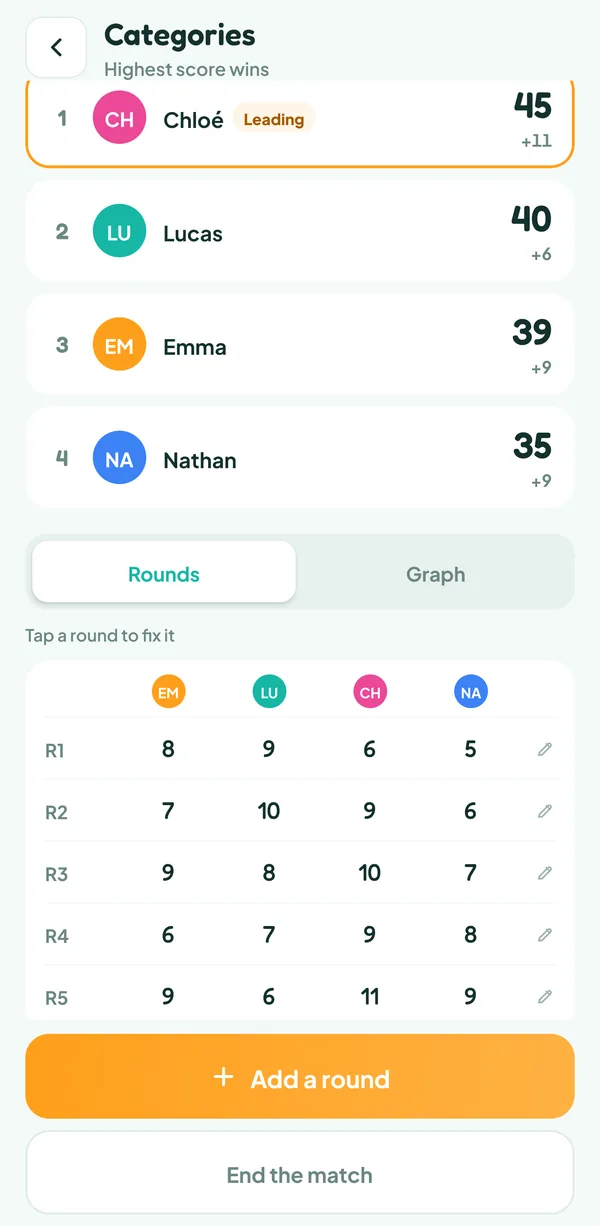
The five rounds of the match, with what each player scored and, below, their total after the round. Lucas leads for three rounds, Chloé catches up with him in the fourth (34 each) and overtakes him in the last one.
| Round | Emma | Lucas | Chloé | Nathan |
|---|---|---|---|---|
| 1 | 8total after the round 8 | 9total after the round 9 | 6total after the round 6 | 5total after the round 5 |
| 2 | 7total after the round 15 | 10total after the round 19 | 9total after the round 15 | 6total after the round 11 |
| 3 | 9total after the round 24 | 8total after the round 27 | 10total after the round 25 | 7total after the round 18 |
| 4 | 6total after the round 30 | 7total after the round 34 | 9total after the round 34 | 8total after the round 26 |
| 5 | 9total after the round 39 | 6total after the round 40 | 11total after the round 45 | 9total after the round 35 |
| Total | 39 | 40 | 45 | 35 |
The Categories game sheet to print
A Categories game sheet on US Letter, landscape, one per player: a box for the player's name, a column for the letter, eight usual categories (country, city, first name, animal, job, fruit or vegetable, thing, brand), the points of each round and the total at the bottom, for 15 rounds. The scoring is recalled under the grid. Print one sheet per player, or let Teamzy keep score.
Download the Categories game sheet (PDF)A match in five rounds, won in the last one
Emma, Lucas, Chloé and Nathan agreed on five rounds, scored 2 / 1 / 0, with six categories: country, city, first name, animal, job, fruit or vegetable (12 points at most per round). After four rounds, Lucas and Chloé are tied on 34 points each, ahead of Emma (30) and Nathan (26).
- 1Round 5, the letter drawn is P. Chloé fills her six boxes first and shouts “Stop!”: everyone puts their pencil down.
- 2The answers are compared, category by category. Paris is written three times, by Emma, Lucas and Nathan: 1 point each. Prague, written by Chloé alone, is worth 2 points.
- 3Nathan suggests Pegasus as an animal. The table votes: an animal that does not exist, word refused, 0. Lucas found no first name: empty box, 0.
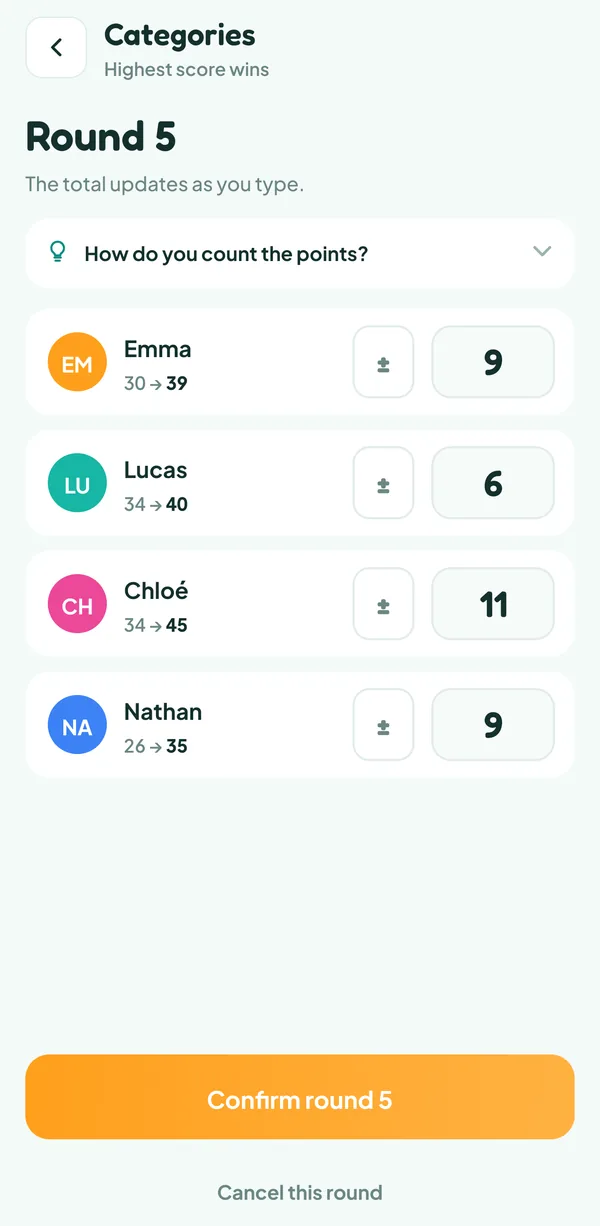
- 4Chloé has only one shared answer, Panda, with Lucas. Five answers nobody else has and one shared: 5 × 2 + 1 = 11. Emma scores 9, Nathan 9 and Lucas 6.
- 5The totals: Chloé 45, Lucas 40, Emma 39 and Nathan 35. The table had agreed on five rounds: the match ends there.
Chloé wins with 45 points, ahead of Lucas (40), Emma (39) and Nathan (35).
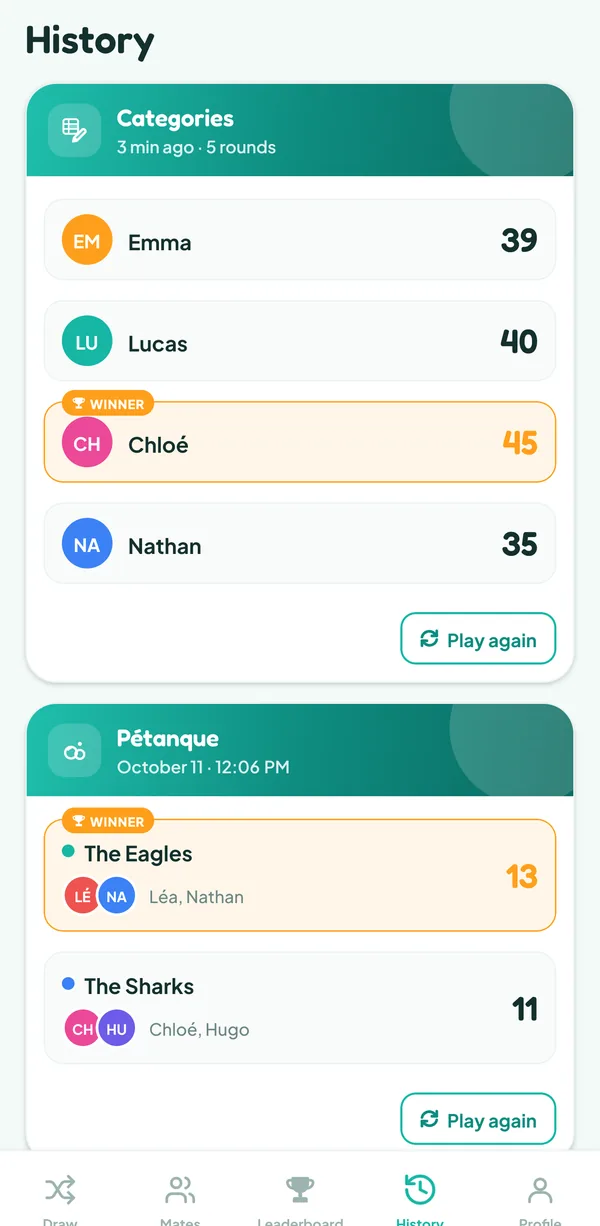
In Teamzy, each round, you type everyone's total, and the match total updates as you type. After the last round agreed on, tap “End the match”: the app names the winner and keeps the match in the history, with its curve.
The questions that come up at the table
The answers are compared category by category. An answer nobody else has is worth 2 points. An answer at least one other player also has is worth 1 point, for each of those who have it: in the example, Paris written three times gives 1 point to each of the three. An empty box or a refused word is worth 0. Everyone adds up their line, and the totals add up from round to round.
The Categories game on WikipediaThe most widespread after 2 / 1 / 0 is 20 / 10 / 5, the classic in Germany: 20 points if you are the only one who found a word in the category, 10 for an answer nobody else has, 5 for a shared answer, 0 for an empty box. You also come across 10 / 5 / 0: 10 for a unique answer, 5 for a shared one. In Scattergories, Hasbro's boxed version, only a unique answer scores, 1 point. Some tables give 0 to an answer written by more than two players, or 1 extra point to whoever shouted “Stop!”. In Teamzy, you type the total of the round: every scale works. Teamzy is not affiliated with Hasbro.
Whoever wrote it explains their word, then the table votes: by majority, the word stands or scores 0. A dictionary can settle it. The simplest is to agree before playing on what is allowed: brand names, foreign words, spelling mistakes, answers that are too vague. In the example, Pegasus as an animal is refused: it does not exist.
As soon as a player has filled every box and shouts “Stop!”: everyone puts their pencil down, even in the middle of a word. Some tables prefer a time set in advance, with a sand timer or a kitchen timer. To draw the letter, one player silently runs through the alphabet and another says “Stop”: the letter they stopped at is the one of the round.
The classics: country, city, first name, animal, job, fruit or vegetable, thing, brand. You can add more to suit the table: celebrity, movie, sport, color, dish. The more categories, the more points a round gives: with six categories scored 2 / 1 / 0, it is 12 points at most. The game sheet to print on this page has eight usual categories, and a table can also write its own at the top of the columns.
After the number of rounds agreed on before playing, after going through the alphabet, or when a player reaches a score set in advance. The highest total wins. In Teamzy, there is no target: you tap “End the match” when the table has decided to stop, and the app names the winner.
You play one more round to separate the tied players. In Teamzy, just add a round before ending the match. If the match ends on a tie, it is a tie: the win is shared.
The grid stays on paper: after each round, everyone adds up their line and you type those totals into the app. Teamzy adds them up, shows who is leading and recalls the scoring in the “How do you count the points?” help. You find the match in the history, with its curve and the leaderboard.
Your next game of Categories, without a single sum
Type everyone's total each round, let the app add it up and name the winner, and find your matches in the history. Free to start, Premium as a one-time purchase, no account and no ads.