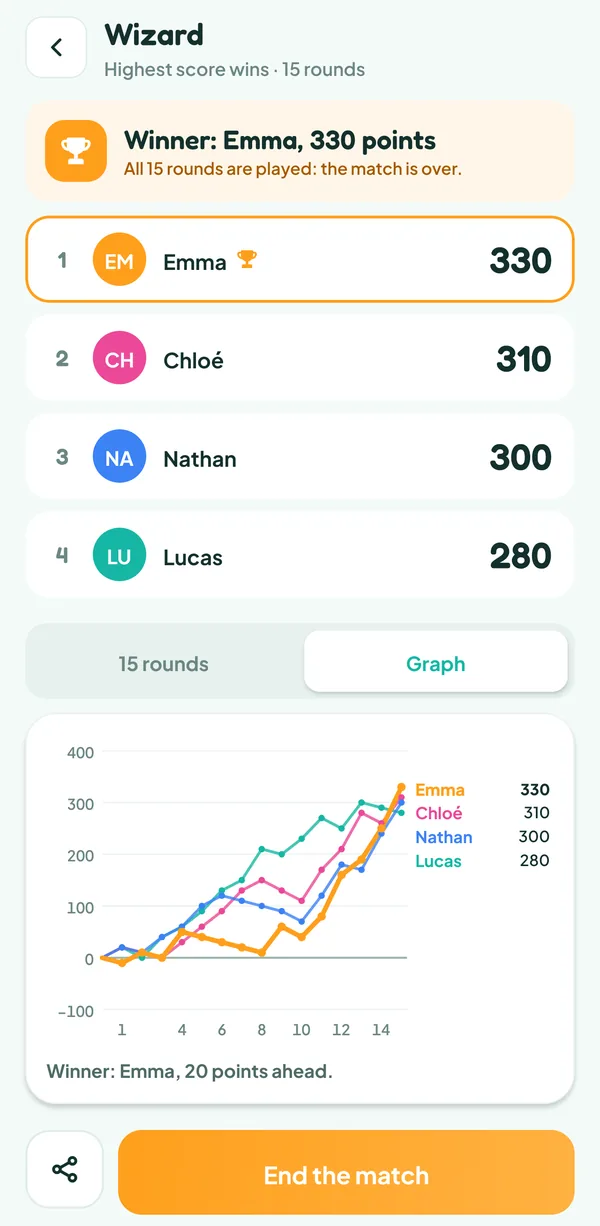
Score Wizard, round after round
Each round, you type everyone's points, negatives included: Teamzy adds up the totals, knows how many rounds to play for the number of players, ends the match after the last one and names the winner.
Wizard in 30 seconds
Wizard is a trick-taking game by Ken Fisher, for 3 to 6 players, free-for-all. The deck has 60 cards: 52 cards in four suits, plus 4 Wizards, which beat everything, and 4 Jesters, which lose to everything. In round 1 everyone gets 1 card, in round 2 two, and so on until all the cards have been dealt. Before playing, everyone bids how many tricks they will take. It all comes down to that bid: hitting it exactly scores points, missing it costs points, one trick too many as much as one too few. The highest total after the last round wins.
What a bid is worth
At the end of each round, everyone compares their tricks with their bid. Bid made: 20 points, plus 10 a trick taken; bidding 0 and taking none is therefore worth 20. Bid missed: 10 points off per trick over or under, and the tricks taken score nothing. No card is worth points. The points add up from round to round, and the highest total wins once all the cards have been dealt.
The scoring, the number of rounds and ties
| What counts | Points |
|---|---|
| Bid made, bonus | 20 |
| Bid made, each trick taken | 10 |
| Bid missed, each trick off (over or under) | -10 |
| Example: bid 2, took 2 | 40 |
| Example: bid 0, took 0 | 20 |
| Example: bid 2, took 1 | -10 |
| Number of rounds | 20 rounds with 3 players, 15 with 4, 12 with 5, 10 with 6 |
| Same total at the end | shared win (tie) |
The points of a round, trick by trick
A bid made is worth 20 points, plus 10 a trick: 20 for a bid of 0 made, 120 for 10 tricks, and up to 220 for 20 tricks in the last round with 3 players. A bid missed costs 10 points per trick off, however many tricks were taken.
| Tricks | Bid made: that many tricks bid and taken | Bid missed: that many tricks off |
|---|---|---|
| 0 | 20 | none off |
| 1 | 30 | -10 |
| 2 | 40 | -20 |
| 3 | 50 | -30 |
| 4 | 60 | -40 |
| 5 | 70 | -50 |
| 6 | 80 | -60 |
| 7 | 90 | -70 |
| 8 | 100 | -80 |
| 9 | 110 | -90 |
| 10 | 120 | -100 |
The number of rounds by players
One more card each round, until the 60 cards have been dealt: with 4 players, 15 rounds, and 15 cards each in the last one. The more players, the shorter the match.
| Players | Rounds |
|---|---|
| 3 players | 20 |
| 4 players | 15 |
| 5 players | 12 |
| 6 players | 10 |
The last round of the example, player by player
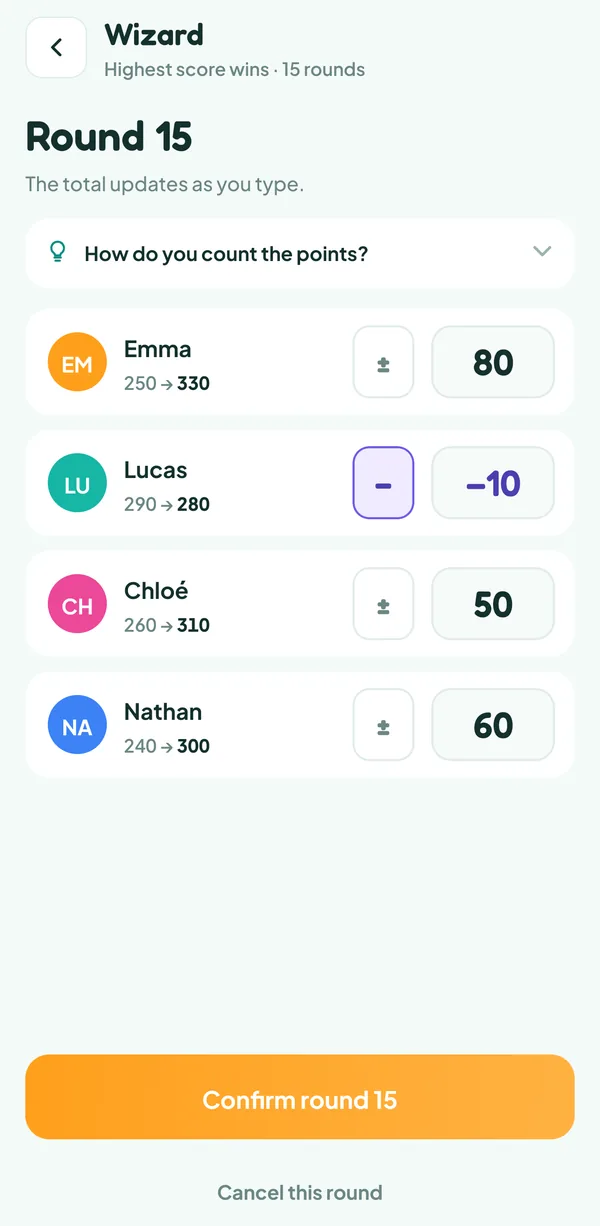
Round 15 of the match told below, with 15 cards each. The bids add up to 16 tricks with 15 to play: at least one player is going to miss.
| Player | Bid | Tricks taken | Working | Points |
|---|---|---|---|---|
| Emma | 6 | 6 | made: 20 + 6 × 10 | 80 |
| Lucas | 3 | 2 | missed: 1 × -10 | -10 |
| Chloé | 3 | 3 | made: 20 + 3 × 10 | 50 |
| Nathan | 4 | 4 | made: 20 + 4 × 10 | 60 |
| Total | 16 | 15 | ||
The sheet of the example
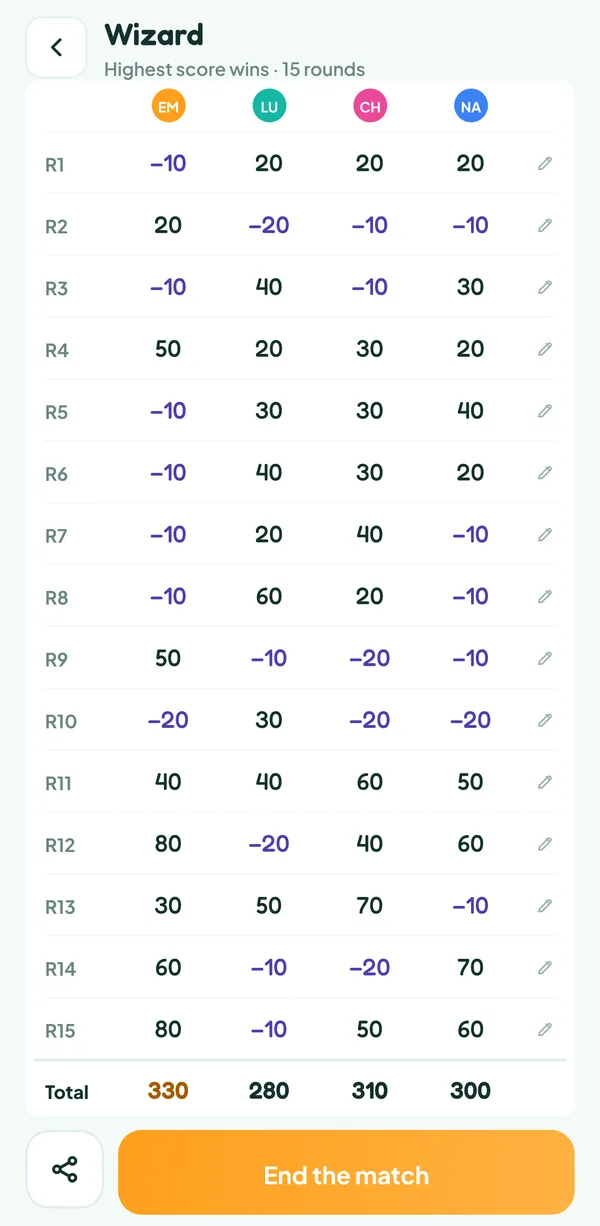
The 15 rounds of the four-player match told below: for each player, their points and, in small print, their bid and the tricks they took. A negative score is a bid missed. The “After 14 rounds” line shows Lucas ahead before the last one.
| Round | Emma | Lucas | Chloé | Nathan |
|---|---|---|---|---|
| 1 | -10 (bid 0, took 1) | 20 (bid 0, took 0) | 20 (bid 0, took 0) | 20 (bid 0, took 0) |
| 2 | 20 (bid 0, took 0) | -20 (bid 2, took 0) | -10 (bid 1, took 2) | -10 (bid 1, took 0) |
| 3 | -10 (bid 1, took 0) | 40 (bid 2, took 2) | -10 (bid 1, took 0) | 30 (bid 1, took 1) |
| 4 | 50 (bid 3, took 3) | 20 (bid 0, took 0) | 30 (bid 1, took 1) | 20 (bid 0, took 0) |
| 5 | -10 (bid 0, took 1) | 30 (bid 1, took 1) | 30 (bid 1, took 1) | 40 (bid 2, took 2) |
| 6 | -10 (bid 2, took 3) | 40 (bid 2, took 2) | 30 (bid 1, took 1) | 20 (bid 0, took 0) |
| 7 | -10 (bid 2, took 3) | 20 (bid 0, took 0) | 40 (bid 2, took 2) | -10 (bid 3, took 2) |
| 8 | -10 (bid 3, took 2) | 60 (bid 4, took 4) | 20 (bid 0, took 0) | -10 (bid 3, took 2) |
| 9 | 50 (bid 3, took 3) | -10 (bid 1, took 2) | -20 (bid 4, took 2) | -10 (bid 3, took 2) |
| 10 | -20 (bid 5, took 3) | 30 (bid 1, took 1) | -20 (bid 6, took 4) | -20 (bid 0, took 2) |
| 11 | 40 (bid 2, took 2) | 40 (bid 2, took 2) | 60 (bid 4, took 4) | 50 (bid 3, took 3) |
| 12 | 80 (bid 6, took 6) | -20 (bid 2, took 0) | 40 (bid 2, took 2) | 60 (bid 4, took 4) |
| 13 | 30 (bid 1, took 1) | 50 (bid 3, took 3) | 70 (bid 5, took 5) | -10 (bid 5, took 4) |
| 14 | 60 (bid 4, took 4) | -10 (bid 0, took 1) | -20 (bid 2, took 4) | 70 (bid 5, took 5) |
| After 14 rounds | 250 | 290 | 260 | 240 |
| 15 | 80 (bid 6, took 6) | -10 (bid 3, took 2) | 50 (bid 3, took 3) | 60 (bid 4, took 4) |
| Total | 330 | 280 | 310 | 300 |
The score sheet to print
A Wizard score sheet in US Letter, for 3 to 6 players and 20 rounds, enough to play with 3: for each player, their bid, the tricks they took and their total every round, and the line where the match ends for each number of players. The scoring is recapped at the bottom. Print it for your next match, or let Teamzy keep score.
Download the Wizard score sheet (PDF)A game of Wizard turned around in the last round
Emma, Lucas, Chloé and Nathan play with four: 60 cards divided by 4, the match lasts 15 rounds. After round 14, Lucas leads with 290 points, ahead of Chloé (260), Emma (250) and Nathan (240). One round left, with 15 cards each.
- 1Round 15, everyone bids: 6 tricks for Emma, 3 for Lucas, 3 for Chloé and 4 for Nathan. That makes 16 tricks bid with 15 to play: somebody is going to miss.
- 2Emma takes her 6 tricks: 20 + 6 × 10, that is 80 points. Chloé takes her 3 (50 points) and Nathan his 4 (60 points).
- 3Lucas takes only 2 of the 3 he bid: one trick off, -10. His 2 tricks score nothing.
- 4The totals: Emma 250 + 80 = 330, Chloé 260 + 50 = 310, Nathan 240 + 60 = 300 and Lucas 290 - 10 = 280.
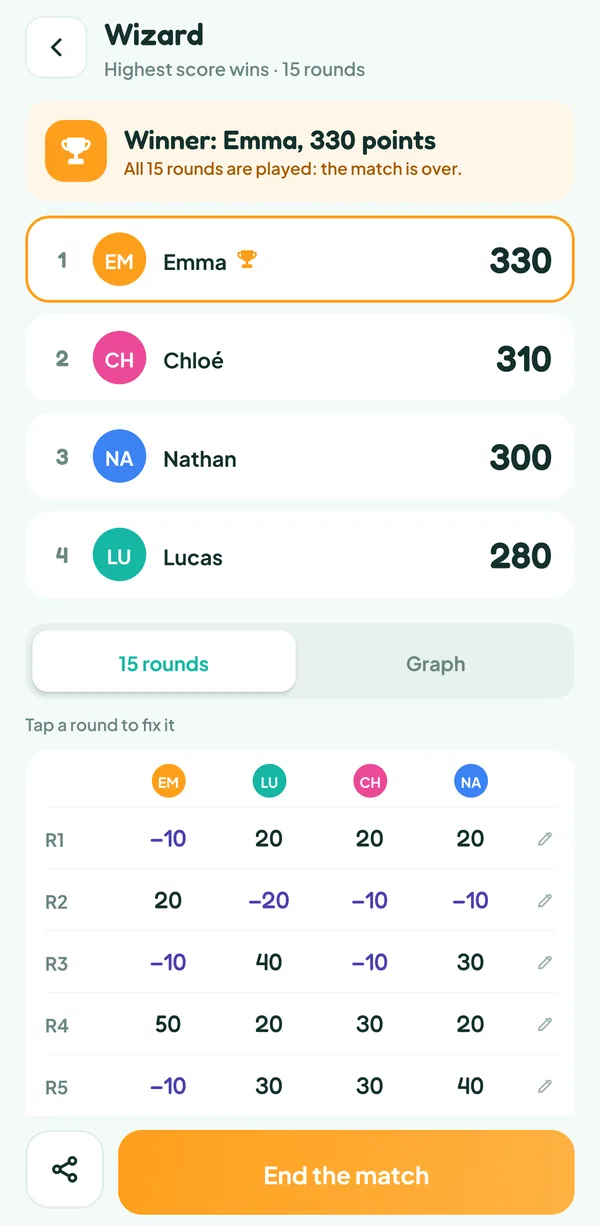
Emma wins with 330 points, ahead of Chloé (310), Nathan (300) and Lucas (280), who went from first to last in a single round. In Wizard, the bid counts more than the tricks, and a 15-card round can change everything.
In Teamzy, each round, you type everyone's points: 80 for Emma, -10 for Lucas with the ± button, 50 and 60. The app adds up the totals, knows that with four the match lasts 15 rounds, stops on its own after the last one (“All 15 rounds are played: the match is over.”) and names the winner.
The questions that come up at the table
At the end of each round, everyone compares their tricks with their bid. Bid made: 20 points, plus 10 a trick taken (bid 2, took 2: 40). Bid missed: -10 per trick off, over or under (bid 2, took 1: -10; bid 1, took 4: -30). The points add up from round to round, and the highest total wins.
Wizard rules from U.S. Games Systems (PDF in English, French and Spanish)20 points if you take no trick: it is a bid made, with no trick to add. If you take one, that is one trick off: -10. In the example match, in round 1, with 1 card each, all four players bid 0. Emma takes the only trick and loses 10 points; Lucas, Chloé and Nathan score 20.
As many rounds as it takes to deal the 60 cards, one more each round: 20 rounds with 3 players, 15 with 4, 12 with 5 and 10 with 6. The last one is played with all the cards in hand. In Teamzy, the app reads the number of players of the match, shows the number of rounds under the name of the game and ends the match after the last one.
Yes, in the basic rules: the bids may add up to more, fewer or as many tricks as there are to play. A variant in the Amigo rules, “Plus/minus Eins”, forbids it: the total of the bids must be different, so at least one player misses every round. The scoring does not change, and in Teamzy you type the points the same way.
The Amigo rules say so: the players tied on the highest total share the win. Teamzy does the same: the same total at the end gives a tie, a shared win.
No. In Wizard, no card is worth points: only the tricks count, compared with the bid. A Wizard wins the trick it is played in (the first one played, if there are several), a Jester almost always loses it. Both help you hit your bid: take a trick you promised, or dodge one too many.
It is a cousin trick-taking game: you also bid the number of tricks you will take. It is played with a standard deck, with no Wizards or Jesters, and its scoring changes from table to table (a fixed bonus for a bid made, a point a trick, a penalty or not for a bid missed). In Teamzy, add it as a game of your own “In rounds” and type everyone's points by your table's rules.
At the end of the round, type everyone's points: 80 for a bid of 6 made, -10 for one trick off with the ± button. The scoring, with examples, is in the “How do you count the points?” help. The app adds up the totals, ranks from highest to lowest, ends the match after the last round and keeps it in the history, with its curve.
Your next game of Wizard, with no pen and paper
Type the points of each round, negatives included, let the app add up the totals, count the rounds and name the winner, and find your matches in the history. Free to start, Premium as a one-time purchase, no account and no ads.