Keep score at The Builders: Middle Ages, from buildings to coins, and the tiebreaker
You type the points of your buildings and machines, then your coin points (1 per full 10 coins): Teamzy adds them up. A tie? The points of the buildings, then the coins, name the winner.
The Builders: Middle Ages in 30 seconds
The Builders: Middle Ages (Les Bâtisseurs : Moyen-Âge in France) is a card game by Frédéric Henry, published by Bombyx, in which 2 to 4 players hire workers to finish buildings and machines, which earn victory points and coins. As soon as someone reaches 17 points with their buildings and machines (coins do not count yet), the round is finished. Everyone then adds 1 point for every full 10 coins they have left: the highest total wins, and the points of the buildings, then the coins, break a tie.
Where the points come from, and who wins a tie
Each finished building or machine earns the victory points printed on its card, plus some coins. At the end of the game, every full 10 coins you still hold are worth 1 more point. The highest total wins. On a tie, you compare the points of the buildings first, then the number of coins.
Points, the end of the game and the tiebreaker
| What counts | Points |
|---|---|
| Finished building or machine | what it says |
| Every 10 coins | 1 |
| End of the match | At 17 points, finish the turn |
| Tie | buildings, then coins |
The coins of the example
Lucas, Emma, Hugo and Léa hold these coins at the end of the game. Only full groups of 10 count: 34 coins make 3 points, not 3.4.
| Lucas | Emma | Hugo | Léa | |
|---|---|---|---|---|
| Coins at the end of the game | 12 | 34 | 21 | 8 |
| Coin points | 1 | 3 | 2 | 0 |
The example score sheet
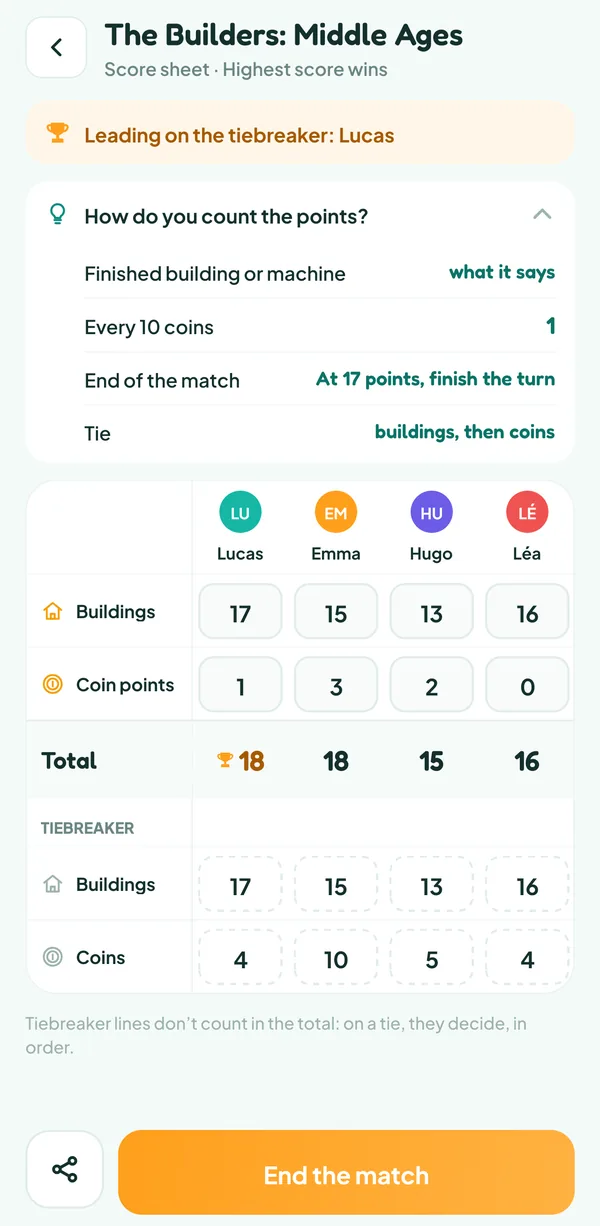
The end of the game told below. Lucas and Emma are tied on 18 points: under the total, the two tiebreak lines, in order, make the difference.
| Lucas | Emma | Hugo | Léa | |
|---|---|---|---|---|
| Buildings | 17 | 15 | 13 | 16 |
| Coin points | 1 | 3 | 2 | 0 |
| Total | 18 | 18 | 15 | 16 |
| Tiebreaker | ||||
| Buildings | 17 | 15 | 13 | 16 |
| Coins | 4 | 10 | 5 | 4 |
Lucas wins on the tiebreak: 17 points of buildings against 15 for Emma.
The end of a game, decided on the buildings
Lucas, Emma, Hugo and Léa play a four-player game, each for themselves. Lucas has built the most, Emma has piled up the coins.
- 1At the end of his turn, Lucas reaches 17 points with his buildings and machines: he triggers the end of the game. Coins do not count towards it. Those who have not yet played in this round take a last turn, so that everyone has had the same number of turns.
- 2The count. Buildings and machines finished: Lucas 17, Emma 15, Hugo 13 and Léa 16.
- 3Then the coins, in full groups of 10: Lucas has 12, so 1 point; Emma 34, so 3; Hugo 21, so 2; Léa 8, so 0.
- 4Totals: Lucas 18, Emma 18, Léa 16 and Hugo 15. Lucas and Emma are tied for the lead.
- 5The tiebreak starts with the points of the buildings: Lucas 17, Emma 15. That settles it: the coins do not come into play, even though Emma has more of them (10 against 4).
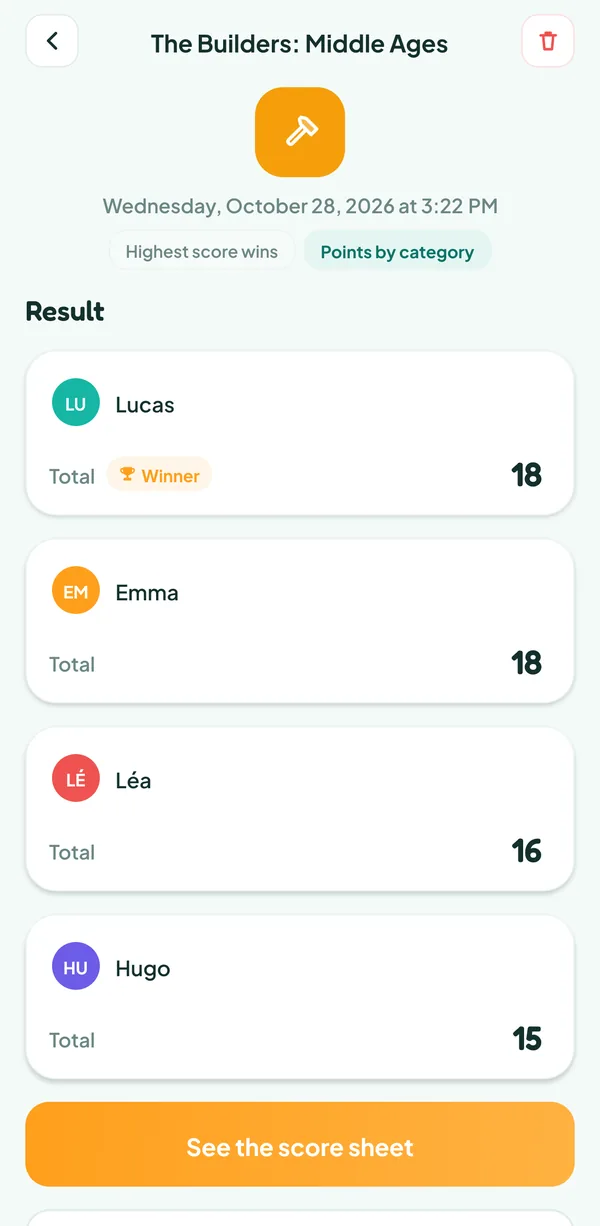
Lucas wins on the tiebreak, with 17 points of buildings against 15 for Emma. Ranking: Lucas, Emma, Léa, Hugo.
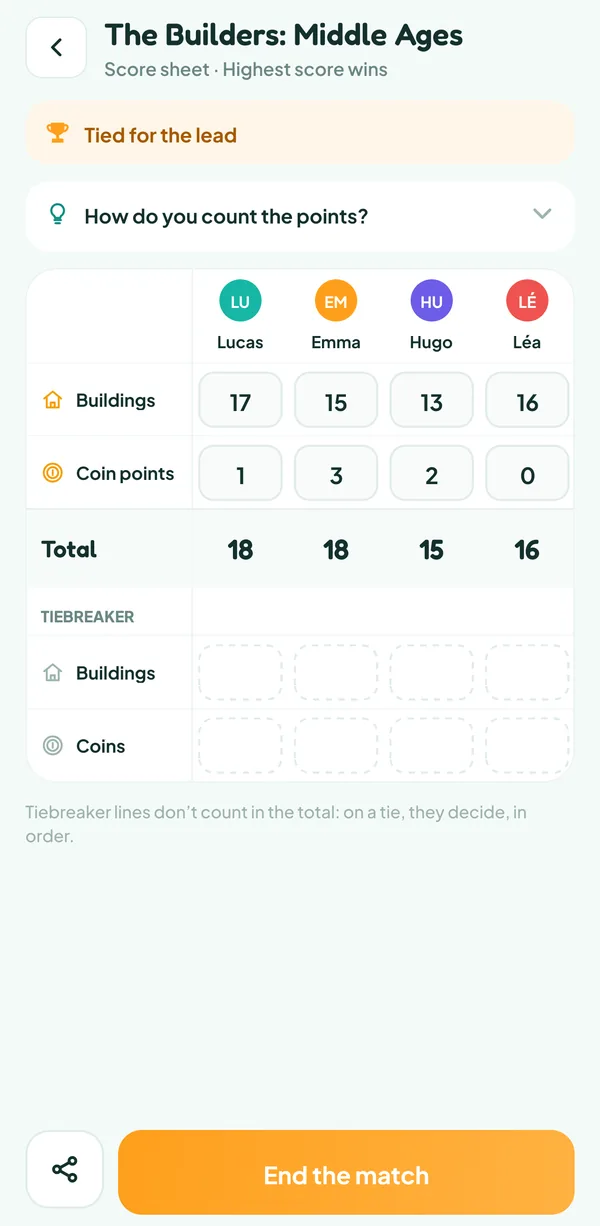
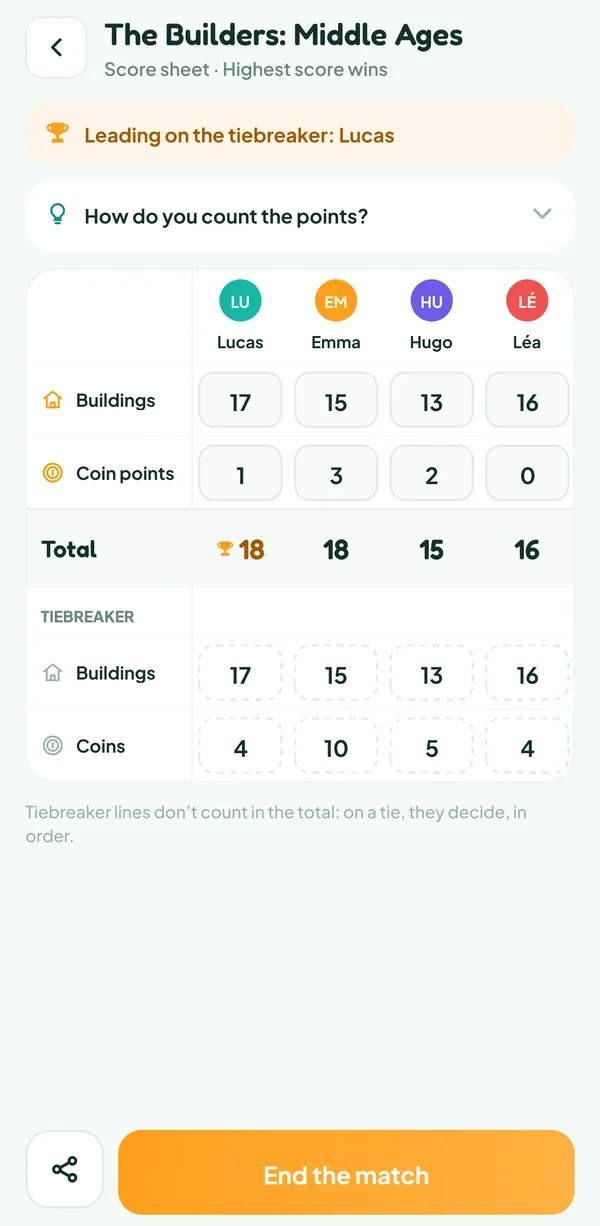
In Teamzy, you type everyone's points of buildings on the first line, then their coin points on the second. The total works itself out and the app shows "Tied for the lead". You then type the buildings and the coins a second time on the two tiebreak lines. They are not added to the points: they only count on a tie, in that order. The app names Lucas and keeps the game in the history.
The questions that come up at the table
Each finished building or machine earns the victory points it shows once flipped over. At the end of the game, you add 1 point for every full 10 coins you have left: silver coins are worth 1, gold coins 5. The highest total wins. In Teamzy, you type the points of your buildings and machines on one line and your coin points on the other, and the total works itself out.
The Builders: Middle Ages rulebook, by Bombyx (in French)When a player has 17 or more victory points at the end of their turn, counting their finished buildings and machines but not their coins. Those who have not yet played in that round take a last turn, so that everyone has had the same number of turns: if the first player triggers the end, all the others still play; if it is the last player, the game stops at the end of their turn. Everyone then counts their points, coins included.
No. To trigger the end of the game, only finished buildings and machines count. Coins are added only in the final count, at 1 point for every full 10. So you can go past 17 points in the final count without having triggered the end.
Only full groups of 10 coins earn a point: 9 coins are worth nothing, 10 to 19 coins 1 point, 20 to 29 coins 2 points, and so on (34 coins make 3 points). Count the value of your coins, not how many there are: a silver coin is worth 1, a gold coin 5. Type the result on the Coin points line.
The French rulebook gives the win to the player with the most points from buildings; if still tied, to the player with the most coins. In the app, type these two amounts on the tiebreak lines, under the total: they are not added to the points and only count on a tie. If the tie holds after the coins, the rulebook says nothing more and Teamzy records a tie.
The number of coins you have in front of you at the end of the game, not their value: the French rulebook breaks ties on the most pièces (the coins themselves), not écus (their value). A gold coin is worth 5 but counts as one coin: with 2 gold coins and 3 silver coins, you have 5 coins, worth 13.
Yes for the points: a machine is a special kind of building (8 of the 42 Building cards), built like the others and earning its victory points once finished. So it counts in your points of buildings, including to reach 17. It then stays in play and joins your workers, with no coins to pay to send it to work. Note its points on the Buildings line.
Yes: the sheet has one total per player, from 2 to 4, each for themselves, like the game. It has one line for the buildings, one for the coin points and two tiebreak lines, and nothing else to enter: workers, resources and actions are played on the table.
Your next game of The Builders: Middle Ages, without pen or paper
Type the points of your buildings and your coins, and find your games in the history. Free to start, Premium as a one-time purchase, no account and no ads.