Count Rummikub points, without redoing the sums
Tick who emptied their rack, type the tiles the others have left: Teamzy makes them negative, gives the sum to the winner of the round, adds up the totals and names the winner of the match.
Rummikub in 30 seconds
Rummikub is a tile game created by Ephraim Hertzano, for 2 to 4 players, free-for-all. The box holds 106 tiles: 1 to 13 in four colors, two of each, plus 2 jokers. Each player gets 14 on their rack and lays down runs and groups; their first meld must be worth at least 30 points. The first to empty their rack wins the round: the others lose the value of the tiles they have left, and the winner scores the sum. The highest total after the rounds agreed on wins.
What a tile left on your rack costs
During a round, the tiles you lay down score nothing: it is all counted when someone empties their rack. Each other player adds up the value of the tiles they have left, the number printed on them, and loses it. A Joker left on a rack costs 30 points in the English rules, 25 in the multilingual rules (Dutch, German, French, Spanish and Portuguese). The player who went out scores the sum of what the others lose: every round adds up to zero.
The count, blocked rounds and the end of the match
| What counts | Points |
|---|---|
| Each tile left on your rack | its value, negative |
| Joker left on your rack | −30 (−25 in some editions) |
| The first to empty their rack | the sum of the points the others lost |
| Pool empty, nobody can play | the lightest rack wins, each other player loses the gap with it |
| End of the match | after the rounds agreed on |
| Same total at the end | tie |
| English rules | most rounds won wins, then the total |
Round 3 of the example, player by player
The round that turns the match told below: Emma empties her rack while Nathan is stuck with 36 points of tiles. What Lucas, Chloé and Nathan lose, Emma scores.
| Player | Tiles left | Calculation | Points |
|---|---|---|---|
| Emma | 0 | empty rack: 9 + 21 + 36 | 66 |
| Lucas | 9 | loses their 9 points of tiles | -9 |
| Chloé | 21 | loses their 21 points of tiles | -21 |
| Nathan | 36 | loses their 36 points of tiles | -36 |
| Round total | 0 | ||
A blocked round: the lightest rack wins
A made-up example, outside the match told below: the pool is empty and nobody can play. In the English rules, the lightest rack wins the round, here Lucas's; each other player loses the gap between their rack and his, and Lucas scores the sum of the gaps.
| Player | Tiles left | Calculation | Points |
|---|---|---|---|
| Emma | 9 | 4 - 9 | -5 |
| Lucas | 4 | lightest: 5 + 11 + 18 | 34 |
| Chloé | 15 | 4 - 15 | -11 |
| Nathan | 22 | 4 - 22 | -18 |
| Round total | 0 | ||
The sheet of the example
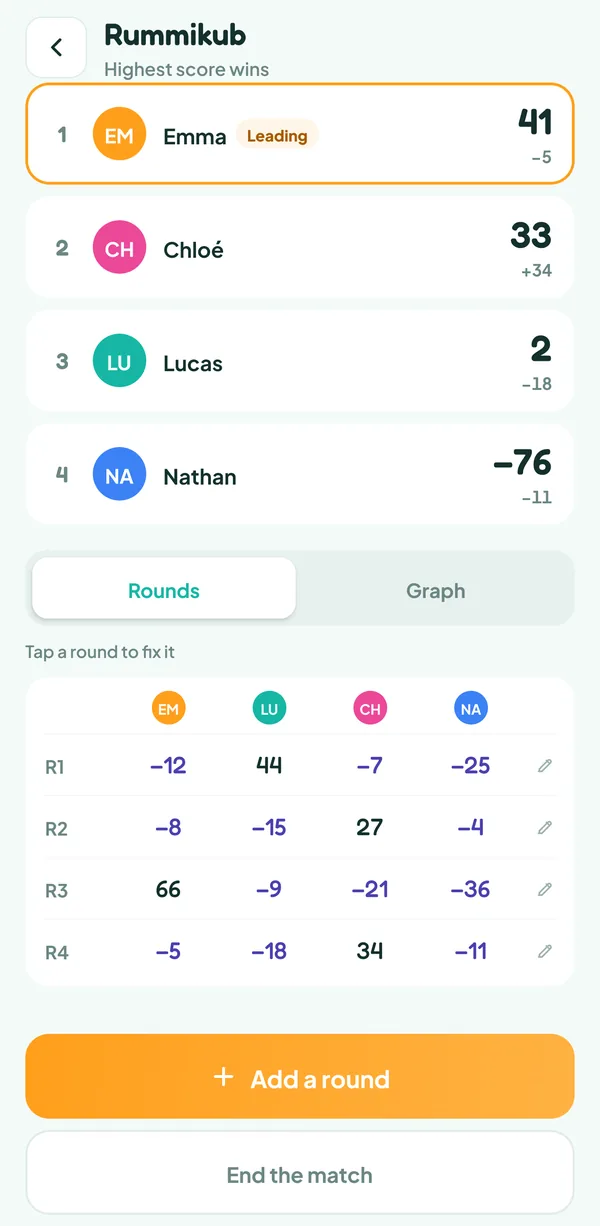
The 4 rounds of the match told below. A dot marks who emptied their rack; the Sum column shows that every round adds up to zero: what some lose, the winner of the round scores.
| Round | Emma | Lucas | Chloé | Nathan | Sum |
|---|---|---|---|---|---|
| 1 | -12 | 44 (emptied their rack) | -7 | -25 | 0 |
| 2 | -8 | -15 | 27 (emptied their rack) | -4 | 0 |
| 3 | 66 (emptied their rack) | -9 | -21 | -36 | 0 |
| 4 | -5 | -18 | 34 (emptied their rack) | -11 | 0 |
| Total | 41 | 2 | 33 | -76 | 0 |
The score sheet to print
A Rummikub score sheet in US Letter, for 2 to 4 players and 15 rounds: for each player, a box to tick if they emptied their rack, their tiles left and their total every round. The count, jokers and blocked rounds included, is recapped at the bottom. Print it for your next match, or let Teamzy keep score.
Download the Rummikub score sheet (PDF)A Rummikub match turned around in round 3
Emma, Lucas, Chloé and Nathan play with four, free-for-all, and agree on four rounds. No Joker left on a rack, no empty pool: each round ends when someone empties their rack.
- 1Round 1: Lucas empties his rack. Emma has 12 points of tiles left, Chloé 7 and Nathan 25: they lose them, and Lucas scores 12 + 7 + 25, that is 44. He takes the lead.
- 2Round 2: Chloé goes out first. Emma loses 8, Lucas 15 and Nathan 4: 27 for Chloé. Lucas still leads with 29, ahead of Chloé (20), Emma (-20) and Nathan (-29).
- 3Round 3: Emma empties her rack while Nathan is stuck with 36 points of tiles. With Lucas's 9 and Chloé's 21, she scores 66 and takes the lead with 46, ahead of Lucas (20), Chloé (-1) and Nathan (-65).
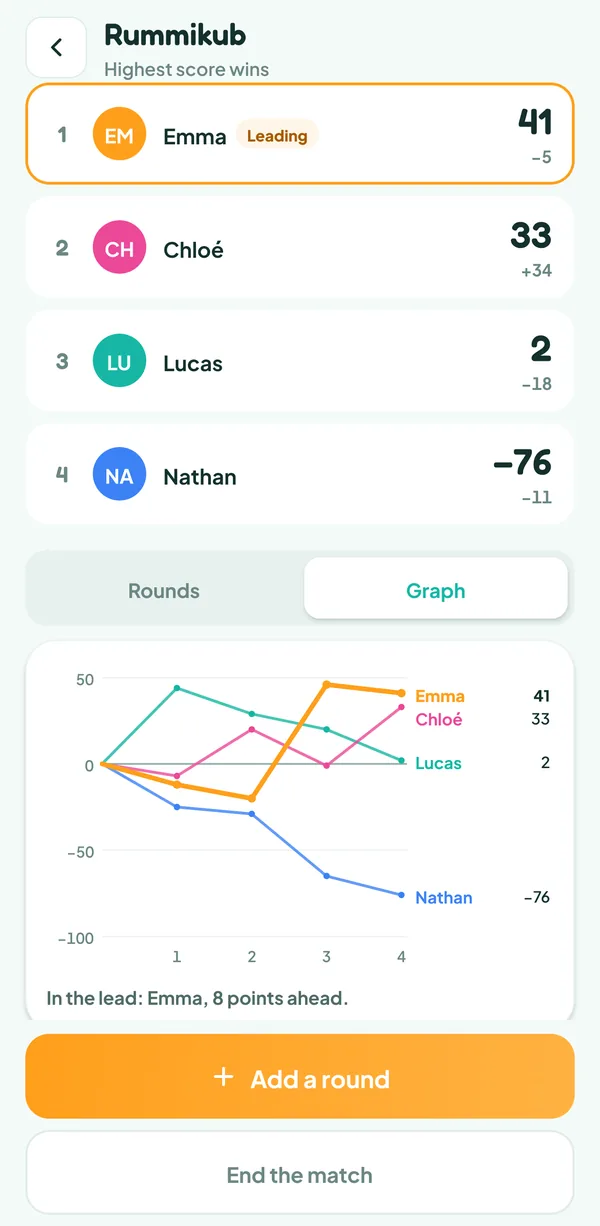
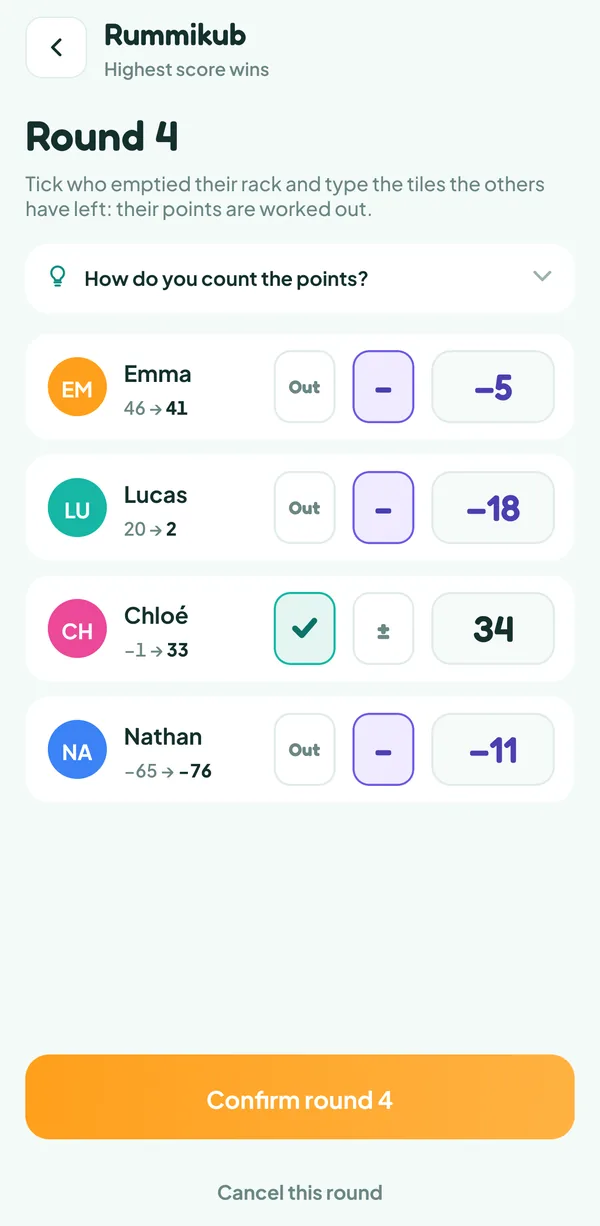
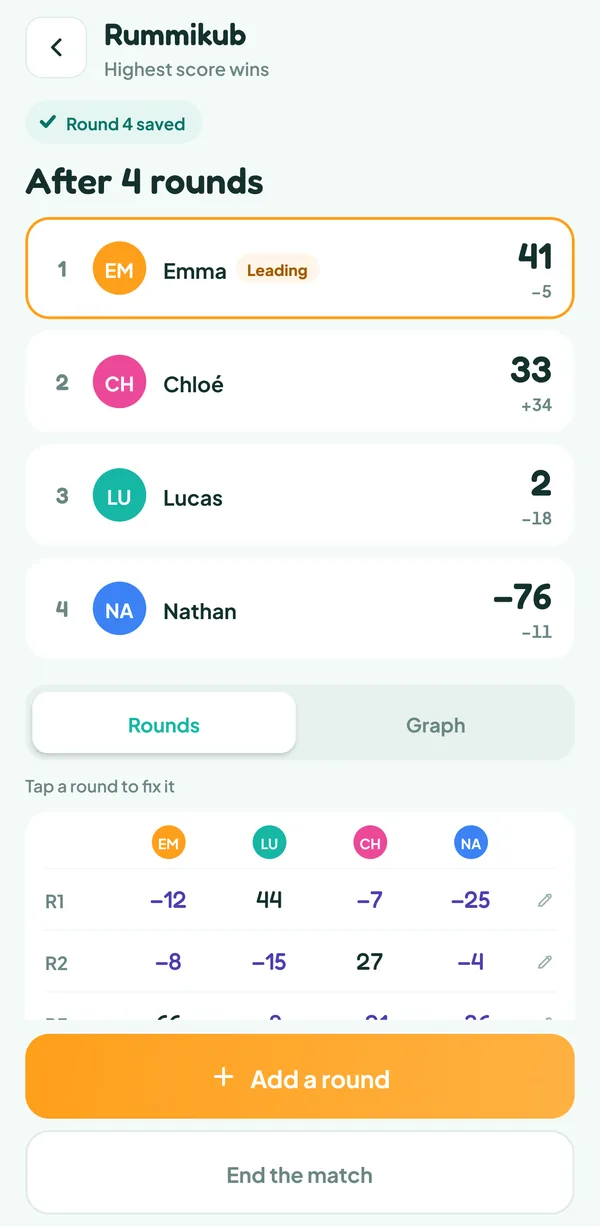
- 4Round 4: Chloé goes out first again and scores 34 (5 from Emma, 18 from Lucas, 11 from Nathan). She climbs to 33, but Emma, on 41, stays 8 points ahead.
Emma wins with 41 points, ahead of Chloé (33), Lucas (2) and Nathan (-76). Since every round adds up to zero, so do the four totals: what Nathan lost, the others scored. In Rummikub, going out fast matters, but not getting stuck with big tiles matters just as much.
In Teamzy, each round, tick “Out” for the player who emptied their rack and type the tiles the others have left: 5 for Emma, 18 for Lucas and 11 for Nathan in round 4. The app makes them negative and gives 34 to Chloé. After round 4, “End the match”: the app names the winner and keeps the match in the history, with its chart.
The questions that come up at the table
When a player empties their rack, the round stops. Each other player adds up the value of the tiles they have left, the number printed on them, and loses it: 12 points of tiles, -12. The player who went out scores the sum of those losses. Points add up from round to round, and the highest total wins.
The official Rummikub rules on rummikub.com, in several languagesIt depends on the rules of your edition: 30 points in the English rules, 25 in the multilingual rules (Dutch, German, French, Spanish and Portuguese). It counts as negative points for the player holding it, and the winner of the round adds it to their sum. On the table, the Joker takes the value of the tile it stands for, including in the first meld.
In the English rules, play goes on until nobody can play any more. The lightest rack then wins the round: each other player loses the gap between their rack and the winner's, and the winner scores the sum of the gaps. In Teamzy, tick “Out” for the lightest rack and type each other player's gap: the app makes them negative and works out the winner's points.
Rummikub rules in English on rummikub.com (PDF)Yes: your first meld must be worth at least 30 points, with tiles from your rack only, without using those already on the table. It changes nothing in the count: a tile laid down no longer counts, only those still on your rack at the end of the round cost points.
As many as you agree on. The English rules group the rounds into series: a series has as many rounds as there are players (4 with four, 3 with three, 2 with two), and the table chooses how many series to play. Teamzy sets no end: once you have played your rounds, “End the match”, and the highest total wins.
The English rules first rank players by the number of rounds won, and points only break ties. Teamzy ranks by the highest total: the same total at the end gives a tie. If your table follows the English rules, the sheet of the match shows who won each round: it is the only positive score in the row.
Tick “Out” for the player who emptied their rack, then type the value of the tiles each other player has left: the app makes them negative and fills in the winner's points. The round is saved as ordinary points, and corrected the same way. The count, jokers included, is in the help “How do you count the points?”. The app adds up the totals, ranks from highest to lowest and keeps the match in the history, with its chart.
Your next Rummikub match, no pen and paper
Tick who emptied their rack, type the others' tiles, let the app add up the totals and name the winner, and find your matches in the history. Free to start, Premium as a one-time purchase, no account and no ads.